
1.2 How Pricing Works
Key Takeaways
- A prediction market contract always trades between $0.00 and $1.00 — the price directly represents the crowd’s estimated probability of the event happening
- If a contract is priced at $0.35, the market is saying: “There’s a 35% chance this event occurs”
- Prices move because of new information, changing sentiment, and shifts in liquidity — not because a bookmaker adjusts a line
- You profit when you buy contracts at prices below the true probability and sell at prices above it — this is the single most important skill in prediction market trading
- Understanding the bid-ask spread, order books, and how fees erode your edge is essential before you place a single trade
Scope: This module covers how pricing works in prediction markets — the mechanics of the $0–$1 scale, why prices move, and how to read what the market is telling you. It does not cover how to identify mispricings or build analytical models (that’s Level 3: Strategies) or how to actually place a trade (that’s Module 1.3).
The $0–$1 Price Scale
In Module 1.1, you learned the foundational concept: price equals probability. Now let’s go deeper into exactly how that works.
Every prediction market contract has a price that moves between two fixed boundaries:
- $0.00 — the contract is worthless. The event did not happen.
- $1.00 — the contract pays out its full face value. The event happened.
Between those two boundaries, the price floats freely, driven entirely by supply and demand from traders who disagree about how likely the event is. There is no bookmaker setting odds. There is no house adjusting lines. The price is pure collective intelligence — or collective ignorance — of every participant in the market.
Reading Prices as Probabilities
The translation is simple:
| Contract Price | Implied Probability | What the Market is Saying |
|---|---|---|
| $0.05 | 5% | “Almost certainly won’t happen” |
| $0.25 | 25% | “Unlikely, but plausible” |
| $0.50 | 50% | “Coin flip — total uncertainty” |
| $0.75 | 75% | “Likely, but not guaranteed” |
| $0.95 | 95% | “Almost certainly will happen” |
This table isn’t an approximation. It’s the exact mathematical relationship. A contract trading at $0.72 means the market collectively believes there is a 72% probability that the event will occur. If you disagree with that number, you have a potential trade.
The Yes/No Relationship
Every prediction market question has two sides:
- “Yes” — you’re betting the event will happen
- “No” — you’re betting the event will not happen
Here’s the critical rule: the price of “Yes” plus the price of “No” must always equal $1.00 (before fees). This is a mathematical identity — an Arrow-Debreu constraint.
If “Yes” trades at $0.65, then “No” must trade at $0.35.
If “Yes” trades at $0.82, then “No” must trade at $0.18.
This relationship holds because the two sides represent the only two possible outcomes. One of them must happen. Together, they account for 100% of the probability space.
💡 Why this matters: If you see a “Yes” contract at $0.70 and think the true probability is only 50%, you don’t necessarily need to sell “Yes.” You can simply buy “No” at $0.30. Both actions express the same view — they just approach it from opposite sides. On some platforms, buying “No” and selling “Yes” are mechanically identical.
A Worked Example: Reading a Real Market
Let’s walk through a concrete example to make this tangible.
Example 1: Federal Reserve Interest Rate Decision
“Will the Federal Reserve cut the federal funds rate at its June 2026 meeting?”
You look at the market on Kalshi and see:
- “Yes” price: $0.42
- “No” price: $0.58
What the market is telling you: There’s a 42% chance the Fed cuts rates in June. More traders believe the Fed will not cut (58%) than believe it will (42%).
You do your own analysis. You read the latest Fed minutes, check the CME FedWatch tool, note that inflation has ticked up slightly, and conclude the real probability of a cut is closer to 25%.
Your trade: You buy “No” at $0.58.
If you’re right (the Fed doesn’t cut), the contract resolves to $1.00. Your profit: $1.00 − $0.58 = $0.42 per contract (before fees).
If you’re wrong (the Fed does cut), the “No” contract resolves to $0.00. Your loss: $0.58 per contract — everything you paid.
This is the fundamental asymmetry of prediction markets: your maximum gain is capped at $1.00 minus your purchase price, and your maximum loss is your entire purchase price.
Example 2: A Technology Market
“Will Apple announce a foldable iPhone before December 31, 2026?”
You check Polymarket and see:
- “Yes” price: $0.12
- “No” price: $0.88
What the market is telling you: Only a 12% chance Apple announces a foldable iPhone this year. The overwhelming consensus is it’s not happening yet.
You’ve followed Apple supply chain leaks closely. Multiple reliable sources have reported advanced hinge prototypes and supplier contracts for flexible OLED panels. You think the true probability is closer to 30%.
Your trade: You buy “Yes” at $0.12.
If you’re right, you collect $1.00. Your profit: $1.00 − $0.12 = $0.88 per contract. An 8.3x return on investment.
If you’re wrong (the likely outcome based on the market’s assessment), you lose $0.12 per contract.
Notice the difference in risk/reward profiles between these two trades. The Fed rate trade offers modest upside ($0.42 on $0.58 at risk). The Apple trade offers massive upside ($0.88 on $0.12 at risk) — but the market thinks you’re probably wrong.
⚠️ This is where most beginners get hurt. Low-priced contracts (under $0.15) offer huge potential payoffs. But research shows these “longshot” contracts are systematically overpriced — meaning the market already overestimates their probability. Empirical data from Polymarket reveals that only 28% of all markets historically resolve to “Yes” — and contracts priced in the $0.01–$0.10 range resolve “Yes” even less frequently than their prices imply (Dune Analytics – Polymarket Calibration Data). We’ll cover this critical bias — the favorite-longshot bias — in depth in Module 3.4.
Why Do Prices Move?
Stock prices move because of earnings, dividends, and expectations about future cash flows. Prediction market prices move for a simpler (but no less important) reason: participants change their beliefs about how likely an event is.
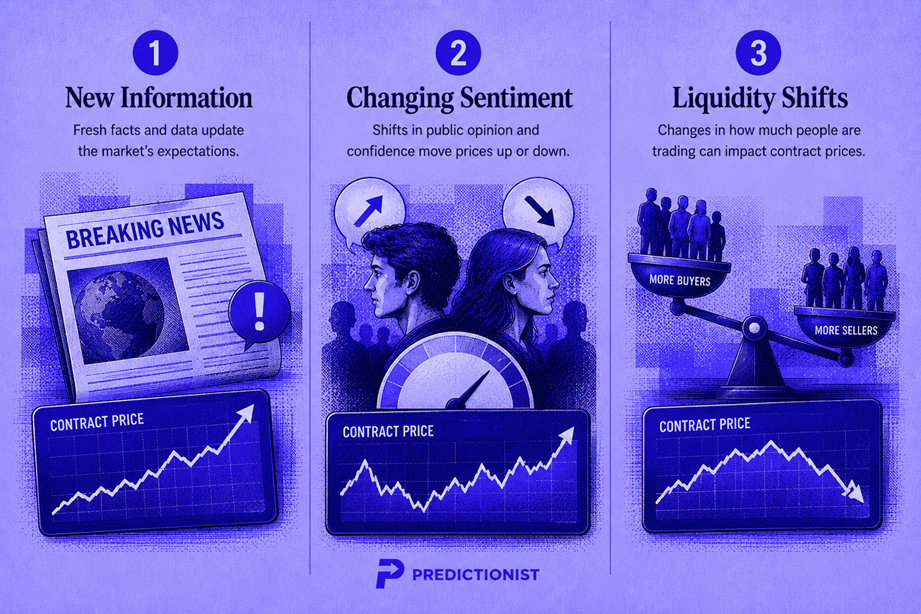
Prices move for three primary reasons:
1. New Information
This is the most obvious driver. When something happens in the real world that changes the probability of an event, traders rush to buy or sell, and the price adjusts.
Example: A poll shows a presidential candidate gaining 5 points in a key swing state. Contracts on that candidate winning the election will rise as traders update their probability estimates.
Academic analysis of the 2024 U.S. presidential election on Polymarket found that trading volume spikes almost instantaneously after major news events — such as presidential debates or significant political shocks. However, the actual price adjustment can take several minutes to fully stabilize, as traders disagree about exactly how the new information maps to the underlying probability (Political Shocks and Price Discovery, arXiv 2603.03152).
This lag between the news event and the price reaching equilibrium is the window where informed and fast-acting traders capture value.
2. Changing Sentiment
Sometimes prices move without any new hard information. Narratives shift. Fear and greed sweep through markets. A prominent Twitter account posts a hot take, and suddenly a contract moves 5 cents.
This happens more than you’d think. Prediction markets — particularly for political and cultural events — are heavily influenced by recency bias (overweighting the latest information) and acquiescence bias (a tendency to bet “Yes” because affirming an event’s occurrence is psychologically easier than imagining its failure). These biases cause prices to overshoot in the short term before reverting.
3. Liquidity Shifts
Sometimes a big player enters or exits a position, and the price moves even though nothing has fundamentally changed about the event’s probability.
Example: A whale purchases $500,000 worth of “Yes” contracts on a market. The price jumps from $0.45 to $0.52 — not because the event is now more likely, but because the whale’s buying pressure pushed up the price. If this doesn’t reflect a change in true probability, the price will eventually revert.
Understanding the difference between information-driven moves and liquidity-driven moves is a key skill. We’ll cover this in depth when we discuss market microstructure in Module 2.1.
The Bid-Ask Spread: The Hidden Cost
So far we’ve talked about “the price” of a contract as if it’s a single number. In reality, every contract has two prices:
- The bid price — the highest price a buyer is currently willing to pay
- The ask price — the lowest price a seller is currently willing to accept
The gap between them is the bid-ask spread.
A Quick Example
Imagine a contract on whether the UK will hold a general election before 2027:
| Price | |
|---|---|
| Best bid (buy) | $0.38 |
| Best ask (sell) | $0.42 |
| Spread | $0.04 (4 cents) |
If you want to buy right now, you pay $0.42 (the ask). If you want to sell right now, you get $0.38 (the bid).
The spread is a cost — it’s money you lose simply for entering and exiting a position. If you buy at $0.42 and immediately sell, you receive $0.38, losing $0.04 per contract.
Why the Spread Matters
For casual traders making a few trades per month, a 3–5 cent spread is manageable. But for active traders, the spread is a silent killer. It eats into your expected value on every trade.
The spread varies by market and platform:
| Market Type | Typical Spread |
|---|---|
| High-liquidity (e.g., U.S. election winner on Polymarket) | $0.01–$0.02 |
| Medium-liquidity (e.g., interest rate decisions on Kalshi) | $0.02–$0.05 |
| Low-liquidity (e.g., niche event on a small platform) | $0.05–$0.15+ |
💡 Pro tip: One of the simplest ways to reduce your trading costs is to avoid crossing the spread. Instead of “market buying” at the ask price, place a limit order at a price between the bid and the ask. You might not get filled immediately, but you’ll often save 1–3 cents per contract — which compounds enormously over hundreds of trades.
How Fees Change the Math
Beyond the spread, every platform charges fees. Understanding fee structures is essential because fees directly reduce your edge.
Here’s how fees vary across major platforms as of early 2026:
| Platform | Fee Structure | Effective Cost |
|---|---|---|
| Polymarket | No explicit trading fee; costs embedded in USDC gas and CLOB spread | Very low (typically < 1%) |
| Kalshi | Exchange-set fees; varies by contract | ~1–3% |
| ForecastEx (Interactive Brokers) | CFTC-regulated exchange fees | ~1–2% |
| FanDuel Predicts | 1% transaction fee, capped at $5 | 1% (max $5 per trade) |
| Limitless | Dynamic: 0.03%–3% based on implied probability | Variable |
| PredictIt (legacy) | 10% on profits + 5% withdrawal fee | >20% effective |
(Source: DeFi Rate – Prediction Market Fees Comparison)
The difference in fee structures is enormous. A strategy that’s profitable on Polymarket (near-zero fees) might be a guaranteed loser on PredictIt (20%+ friction).
Fees and Expected Value: A Quick Calculation
Suppose you identify what you believe is a mispriced contract:
- Market price: $0.50 (50% implied probability)
- Your estimated true probability: 60%
- Your edge: 10 percentage points
Without fees, your expected value per contract is:
0.60 × $0.50 − 0.40 × $0.50 = $0.10
Now add a 3% fee on winnings:
0.60 × ($0.50 − $0.015) − 0.40 × $0.50 = $0.091
With a 10% fee on winnings:
0.60 × ($0.50 − $0.05) − 0.40 × $0.50 = $0.07
With PredictIt-level fees (10% on profit + 5% withdrawal):
Your effective take-home drops even further, potentially cutting your edge by more than half.
The lesson: always calculate your expected value after fees. A trade that looks profitable on paper can be a net loser once friction is accounted for. This is one reason why even sophisticated strategies like cross-platform arbitrage are harder to execute than they appear — the Total Friction Threshold (trading fees + withdrawal costs + spread slippage) can eat the entire profit on a seemingly “risk-free” trade.
Pricing in Practice: How Different Platforms Work
Not all platforms implement pricing the same way. Understanding the two main architectures will help you navigate the ecosystem:
Central Limit Order Book (CLOB)
This is the model used by Polymarket, Kalshi, and most modern platforms. It works like a traditional stock exchange:
- Buyers post limit orders (bids) at prices they’re willing to pay
- Sellers post limit orders (asks) at prices they’re willing to accept
- When a bid matches an ask, a trade executes
- The order book is visible, showing depth at each price level
Advantage: Maximum transparency and price discovery. You can see exactly how much liquidity is available at each price level.
Disadvantage: Requires sufficient liquidity to function. In thin markets, the order book has wide spreads and limited depth.
Polymarket uses a hybrid-decentralized CLOB — orders are matched off-chain for speed, but settled on-chain on the Polygon network using USDC as collateral. This gives it the speed of a centralized exchange with the security and transparency of blockchain settlement.
Automated Market Maker (AMM)
This earlier model — used by platforms like Augur and some decentralized experiments — uses a mathematical formula to set prices instead of matching individual buyers and sellers.
The most common is the Constant Product Formula: x · y = k, where x and y are the quantities of “Yes” and “No” shares, and k is a constant. As traders buy/sell one side, the formula automatically adjusts the price.
Advantage: Always provides liquidity, even in obscure markets with few participants.
Disadvantage: Susceptible to slippage on large orders (the price moves against you as your order fills) and exposes liquidity providers to impermanent loss. For these reasons, the dominant modern platforms have migrated away from AMMs toward CLOBs.
📍 Want to compare how platforms handle pricing? See our side-by-side platform reviews → Platform Directory
Common Pricing Mistakes Beginners Make
Before we move on, here are the most frequent pricing-related errors that cost new traders money:
1. Confusing Price with Value
A contract at $0.05 is not “cheap.” It represents a 5% probability event. If the true probability is 3%, the contract is actually expensive at $0.05 — you’re overpaying by 67% relative to fair value.
Always think in terms of probability, not price. The question is never “is this contract cheap?” — it’s “is the implied probability too high or too low?”
2. Ignoring the Other Side
New traders often fixate on “Yes” contracts. But remember: buying “No” is a perfectly valid trade. In fact, because of the “Yes” overpricing bias we discussed — where markets price 0%–90% contracts above their true probability — systematically buying “No” on overpriced longshots has historically been one of the most reliable sources of edge in prediction markets.
3. Neglecting Resolution Risk
The price you pay is only meaningful if the contract resolves cleanly. Ambiguous resolution criteria can lead to disputed outcomes and unexpected losses. Before trading, always read the resolution rules carefully. There have been controversial cases — such as the Polymarket “Zelenskyy suit” market, which initially resolved to “Yes” before being overturned by UMA oracle vote — where traders who were “right” about the underlying event still lost money due to resolution mechanics.
4. Trading Without Accounting for Fees
As we showed above, fees can consume a significant portion (or all) of your edge. Always model your expected value net of all costs: spread, platform fees, deposit/withdrawal fees, and gas costs (for crypto platforms).
What You Learned
In this module, you learned:
- Prediction market prices are probabilities — a $0.35 contract means the market believes there’s a 35% chance the event occurs
- Yes + No always equals $1.00 — this Arrow-Debreu constraint is the mathematical backbone of binary markets
- Prices move due to new information, changing sentiment, and liquidity shifts — distinguishing between these drivers is a core trading skill
- The bid-ask spread is a real cost — it varies dramatically by market and platform, and can silently erode your returns
- Fees differ enormously across platforms — from near-zero on Polymarket to 20%+ on PredictIt — and they directly impact whether a trade is profitable
- Common beginner mistakes include confusing price with value, ignoring the “No” side, neglecting resolution risk, and failing to account for fees
What’s Next
In the next module, we walk you through placing your first trade — step by step, with screenshots from real platforms. You’ll set up an account, fund it, navigate the interface, and execute a trade from start to finish.
→ Module 1.3: Your First Trade (Step-by-Step)
🎯 Try This Now: Pick a market on Kalshi or Polymarket. Look at the order book. Find the current bid price, ask price, and calculate the spread. Then ask yourself: If I bought at the ask and the market resolved right now, how much would I gain or lose? Practice translating prices into probabilities and thinking about trades in terms of expected value — not just “will this happen or not.”
Predictionist School is a free educational resource from Predictionist.com. We may earn referral commissions from platforms we recommend — see our disclosure policy for details. This content is for educational purposes only and does not constitute financial advice.