
Kalshi
Last updated: July 23, 2026

- CFTC-regulated DCM since November 2020, the first in prediction markets
- Available in all 50 US states at the federal level
- Standard KYC required, dollar funding via debit card, ACH, or wire
- $23.8B in 2025 notional volume, $10.4B monthly by February 2026
Quick facts
| Field | Details |
|---|---|
| Best for | Beginners and US-based sports traders – the regulated rails and credit-card funding cut the friction Polymarket still demands. |
| Beginner friendly | Yes. Standard KYC, dollar funding, mobile app, and no crypto wallet required. |
| Automation | High |
| Pricing | Trading fees built into contract pricing, capped around 2% of max profit, plus 2% debit-card deposit and $2 withdrawal fees. |
| Trust signal | First CFTC-approved DCM for prediction markets (November 2020), $22B valuation after $1B Series F led by Coatue with Sequoia, a16z, Paradigm, Morgan Stanley, and ARK. |
| Main risk | State-level cease-and-desist orders in Nevada, New Jersey, Massachusetts, and others create legal gray zones for sports contracts depending on where users live. |
What is Kalshi?
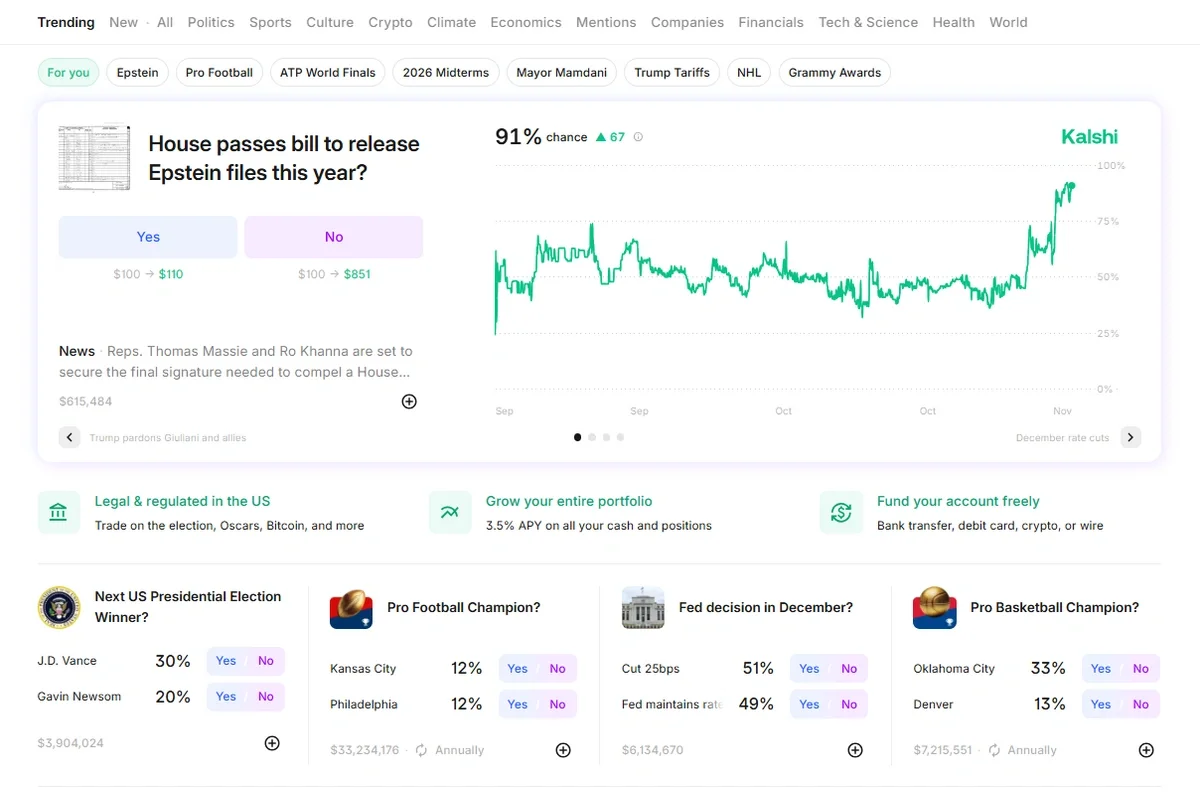
Kalshi is the closest thing to a Bloomberg terminal for real-world events. Co-founded in 2018 by MIT graduates Tarek Mansour and Luana Lopes Lara, the platform spent three years lobbying the CFTC before launching as the first federally regulated event-contract exchange in November 2020. Contracts trade yes/no between $0.01 and $0.99, settling at $1 or $0 on resolution.
The edge is structural – Kalshi operates under federal preemption, which means it can offer sports event contracts in states where traditional sportsbooks cannot. That single regulatory wedge is what turned the platform from a niche econ-bet site into a serious sportsbook competitor in 2025.
Trade with regulated dollars:
Fund via debit card, ACH, or bank wire. No crypto wallet, no Polygon, no off-ramp.Take sports positions outside traditional sportsbooks:
NFL, NBA, NHL, college football, and player props all trade as event contracts. Sports made up roughly 75-90% of Kalshi’s volume by early 2026.Hedge real-world risk:
Markets on Fed rate decisions, CPI prints, weather, and elections work as actual hedges for businesses and individuals exposed to those outcomes.Build on the API:
Kalshi exposes a documented REST and WebSocket API, with Python and other client libraries for bots and quants.
Key features
Federally regulated event contracts: Every contract clears through a CFTC-regulated DCM, with the same oversight regime as CME or ICE.
Deep sports coverage: NFL, NBA, college football, NHL, and Super Bowl markets that hit $871M in a single Sunday during Super Bowl 2026.
Distribution through Robinhood and Webull: Kalshi markets are accessible inside Robinhood, where prediction markets became the fastest-growing product line by revenue in 2025.
Public REST and WebSocket API: Free programmatic access for builders, with Python clients and full order-book streaming.
Platinum loyalty program:
Launched January 2026 for high-volume users, offering merch, early feature access, and private events.
Pros and Cons for Beginners
- Fully CFTC-regulated since November 2020, the most established regulated venue.
- Available in all 50 states at the federal level, with dollar funding.
- Sports coverage that competes directly with traditional sportsbooks.
- Robust REST and WebSocket API for bots and quant strategies.
- Backed by Coatue, Sequoia, a16z, Paradigm, Morgan Stanley, and ARK at $22B valuation.
- Active legal challenges in Nevada, New Jersey, Massachusetts, and others over sports contracts.
- Trading fees built into price reduce theoretical maxes by up to ~2%.
- Sports now dominates 75-90% of volume, crowding out non-sports market depth.
- KYC required to trade, no anonymous or wallet-only path.
- Liquidity outside top sports and political markets can be thin.
Trust and credibility
Kalshi is the most credible regulated name in prediction markets. The platform holds CFTC DCM status since November 2020 and reached a $22B valuation in March 2026 after a $1B Series F led by Coatue, with Sequoia, a16z, Paradigm, Morgan Stanley, and ARK Invest backing. The numbers back the hype: $23.8B in 2025 notional volume (up 1,100% YoY), monthly volume hitting $10.4B by February 2026, and 1.2M active traders. CNN and MSNBC have partnership deals, and Clear Street joined as the first institutional FCM in May 2026. The state-level legal fights are real but so far Kalshi has won the big ones, including a Third Circuit ruling on federal preemption in April 2026.
Established (>12 months).
Automation level: High
| Automation feature | Status |
|---|---|
| Copy trading | No native feature, third-party tools build copy logic on the API. |
| Auto trading rules | Yes through the public API, no rule builder inside the UI. |
| Alerts, real-time notifications | Yes, push notifications on the mobile app plus WebSocket streams for builders. |
| Trading from interface | Yes, via web, iOS, and Android. Also accessible inside Robinhood. |
| API or SDK | Yes, public REST and WebSocket API with Python client. |
| Best automation use case | Sports market-making and event-driven arbitrage strategies built on the WebSocket feed. |
FAQ
Kalshi is a CFTC-regulated event-contract exchange where users trade yes/no contracts on sports, politics, economic data, and other real-world events. Contracts settle at $1 if correct and $0 if wrong, with prices reflecting live probability between $0.01 and $0.99.
Yes. Sign-up takes minutes with standard KYC. Funding works through debit card, ACH, or bank wire, no crypto wallet needed. The mobile app handles trading, deposits, and withdrawals end to end.
No native copy-trading feature. Third-party tools and bots can replicate trades via the public API, but the platform itself focuses on direct user execution rather than mirror trading.
Trading fees are built into contract price, capped at roughly 2% of max profit per trade. Debit-card deposits carry a 2% fee, and debit-card withdrawals come with a flat $2 charge. ACH transfers are free.
Functionally, yes. Sports made up 75-90% of Kalshi’s volume by early 2026, driven by NFL, NBA, and college football. The platform still runs political, economic, and weather markets, but sports dominate the volume mix.
State-level legal action. Federal CFTC approval does not always preempt state gambling regulators – Nevada, New Jersey, Massachusetts, and others have issued cease-and-desist letters over sports contracts. Check your state’s current status before sizing up.


