

Stand is the closest thing prediction markets have to a professional trading terminal. It pulls Polymarket and Kalshi into one interface – one order book view, one alert system, one place to find and copy whales across both venues. For traders who work across both platforms, the time savings alone justify the switch.
The volume backs it up. Stand is approaching $200M in annualized trading volume as of May 2026, with more than a year of live operation. That’s not a number you fake.
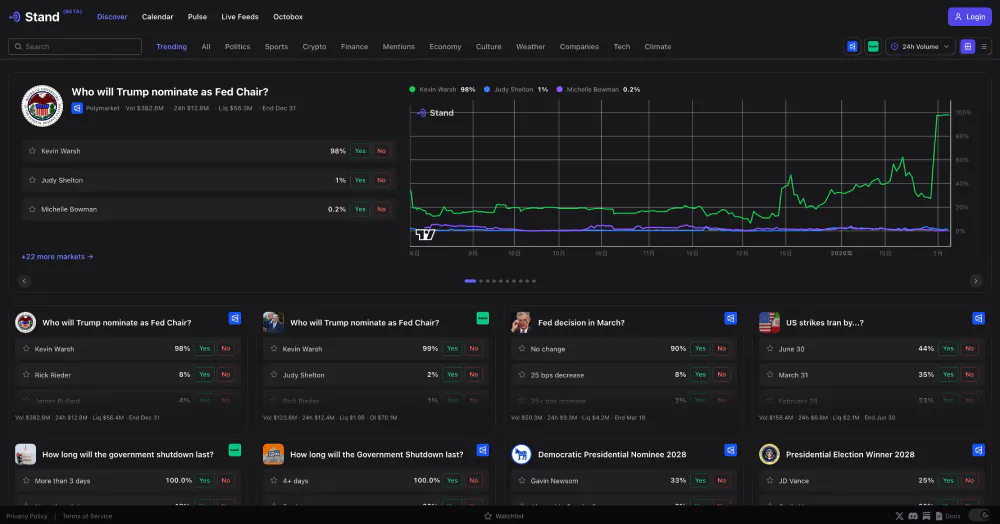
Here’s what you can do:
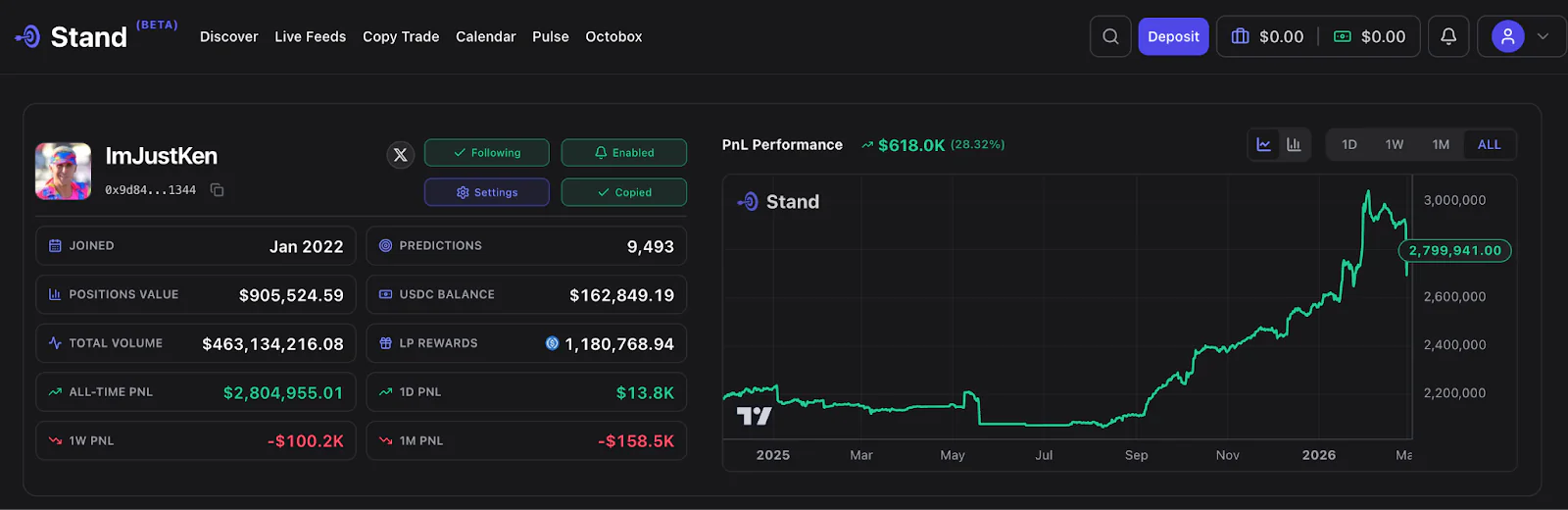
- Copy and counter-trade whale wallets – Follow top Polymarket wallets with live fills and position tracking. Counter-trade systematically losing accounts. Set multiple copy strategies simultaneously. This is structural edge: you act on information most traders can’t monitor manually.
- Automate with TP/SL and pegged orders – Take Profit, Stop Loss, and Pegged (moving limit) orders execute automatically based on your parameters. You set the rules, Stand executes while you’re away.
- Monitor 8 markets simultaneously – The Octobox puts eight order books on one screen. Save layouts, compare odds across venues, act fast when you spot a divergence.
- Get alerts on Discord – Personalized notifications for price moves, whale entries, and market opportunities delivered directly to your Discord DMs.
- Exploit cross-venue price gaps – Similar events often trade simultaneously on Polymarket and Kalshi at different implied probabilities. Stand’s unified feed surfaces these gaps before they close.
Use Cases
Polymarket and Kalshi often price the same event differently. A presidential approval event might trade at 42% on one venue and 46% on the other. Stand’s unified feed makes those gaps obvious – and the integrated trading lets you place positions on both sides from the same screen, without switching tabs. This is a strategy that’s hard to execute without an aggregator.
Stand’s user base is primarily in Europe and Asia, where traders plug prediction market contracts into broader macro strategies – geopolitics, commodity events, economic data releases. The Octobox, real-time feeds, and calendar view for both Polymarket and Kalshi events are built for this kind of systematic monitoring.
Large wallets on Polymarket often signal real information. Stand’s whale tracking and live trade feeds surface those moves in real time. The copy trading feature lets you set automatic follow parameters so you’re in positions seconds after a whale moves – not minutes.
Neither Polymarket nor Kalshi offers native stop-loss orders. Stand does. For traders who run risk-managed position books and need defined exit rules, this is the feature that makes professional risk management possible on these venues.
Pros and Cons
- Aggregates Polymarket and Kalshi into one interface – the only tool with deep integration of both at this volume
- Approaching $200M in annualized trading volume with 12+ months of live operation
- Automated TP/SL and Pegged orders – not available on native platforms
- Copy trading with live fills, counter-trading on losing wallets, and multi-strategy support
- Octobox dashboard: 8 live order books on one screen with layout saves
- Custodial deposit model – you deposit funds into Stand's system, not just connecting a wallet
- US users are geo-blocked from accessing the platform
- Counter-trading lacks rigorous published research on profitability
- No public API or SDK for custom integrations
- Large multi-market exposure from Octobox encourages overtrading for undisciplined traders
Trust and credibility
Stand has been live for over 12 months, which moves it firmly into established territory for a prediction market tool. The co-founders are publicly named – Edward Ridgely (CEO) and Roberto Berwa (MIT engineer). The $200M annualized volume number is real. Coverage in The Defiant and FinanceMagnates confirms third-party attention. The community is active on X and Substack. The main trust concern is the custodial model – your deposited funds are inside Stand’s system, not just a wallet connection. That’s a different risk profile than tools that only touch your wallet for signing.
📍 Before depositing funds into any platform, understand how liquidity works – read our order books and liquidity.
Automation level
| Automation feature | Status |
|---|---|
| Overall level | High |
| Copy trading | Yes – mirrors selected wallets with live fills and multi-strategy support |
| Auto trading rules | Yes – TP/SL, Pegged Orders, batch order management |
| Alerts, real-time notifications | Yes – Discord DMs for whale activity, price moves, and opportunities |
| Trading from interface | Yes – full web terminal with order management |
| API or SDK | No public API |
| Best automation use case | Cross-venue whale copying with automatic TP/SL exits |
📍 See all trading terminal options at predictionist.com/tools.
FAQ
Stand is a professional prediction market trading terminal that aggregates Polymarket and Kalshi into one interface. It offers copy trading, whale tracking, automated TP/SL orders, an 8-market Octobox dashboard, and personalized Discord alerts. Approaching $200M in annualized volume with over 12 months live.
Stand charges no platform fees. You pay only the standard trading fees on Polymarket and Kalshi. The trade-off is that Stand uses a custodial deposit model – you deposit funds into Stand’s system rather than simply connecting a wallet.
Unlike tools that just connect to your existing wallet for signing, Stand requires you to deposit funds into the platform. This gives Stand the ability to execute automated strategies and manage orders – which enables features like TP/SL and AFK copy trading. The risk is that your funds are inside a third-party system. Treat it the same way you’d treat funds on a centralized exchange – only deposit what you actively intend to trade.
No. Stand geo-blocks US users. This reflects the regulatory complexity around prediction markets in the United States. Kalshi is US-regulated, but Stand’s own platform restrictions are separate from the underlying venue rules.
You identify a wallet you want to follow – via Stand’s discovery and search tools – and set copy parameters (size, filters). Stand executes trades in your account when the target wallet moves, using live fill data rather than delayed price signals. You can also counter-trade: automatically take the opposite position from wallets with a track record of losing.
The Octobox is Stand’s multi-market dashboard that displays up to 8 live order books simultaneously on one screen. You can save layouts for specific strategies or market groups. For traders monitoring multiple correlated events – like a set of election markets or sports markets – it eliminates constant tab switching.
The native platforms don’t offer copy trading, whale tracking, automated TP/SL, or cross-venue visibility. Stand adds all of these. The trade-off is the custodial deposit model and geo-blocking for US users. If you’re trading across both venues seriously, Stand’s workflow efficiency gains are hard to replicate manually.