
Polymarket
Last updated: July 23, 2026

- CFTC-regulated DCM (Polymarket US since July 2025)
- Available in most US states, with active legal challenges in several
- Full KYC required on Polymarket US, no KYC on the international platform
- $19B+ in cumulative volume since 2020, largest prediction market by size
Quick facts
| Field | Details |
|---|---|
| Best for | Intermediate traders – those comfortable with USDC wallets and limit-order mechanics get far more out of it than casual bettors. |
| Beginner friendly | Partial. The US app smoothed onboarding, but the main offshore site still expects crypto fluency. |
| Automation | High |
| Pricing | Free on most event markets, small taker fees on short-term crypto markets and the US-regulated site. |
| Trust signal | CFTC Designated Contract Market status on the US site (November 2025), plus Intercontinental Exchange backing the parent at an $8B valuation. |
| Main risk | US users touching the main offshore site via VPN violate the ToS, with account bans documented during high-volume windows. |
What is Polymarket?
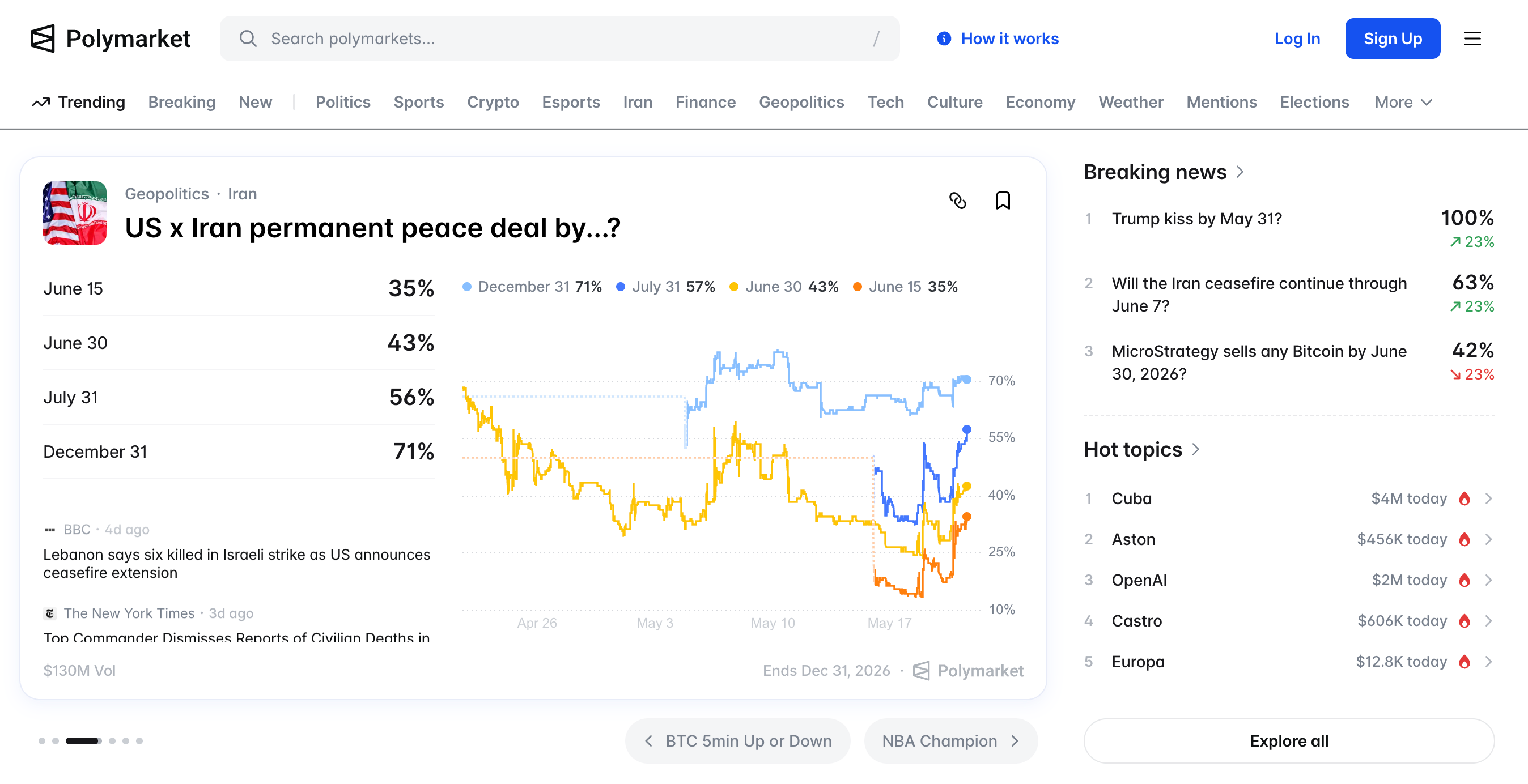
Think of Polymarket as a stock exchange for opinions about the future. Each market is a yes/no question priced between $0 and $1, where the price reads as the crowd’s probability of the event. Right answer settles at $1. Wrong, $0.
The platform runs a central limit order book on Polygon, settles in USDC, and resolves outcomes through UMA’s optimistic oracle. The edge is structural – it offers event markets traditional sportsbooks cannot legally run in most US states – and informational, since news desks and trading floors now read live Polymarket odds as sentiment data.
Trade an event directly:
Pick a market, buy yes or no, sell anytime before resolution.Provide liquidity as a maker:
Post limit orders to earn maker rebates on the US site, or Maker Rewards on the offshore site funded by trading fees.Build on the CLOB API:
A public Python and TypeScript SDK powers bots, dashboards, and copy-traders.Pull the institutional data feed:
Polymarket Signals, distributed through ICE since February 2026, sells normalized prediction-market data to institutional desks.
Key features
Event contracts across many categories: Politics, sports, crypto, culture, world events, and economic data all trade as binary contracts.
Central limit order book model: Maker and taker orders work like a traditional exchange. Most prediction-market competitors run automated market makers, which behave very differently.
On-chain settlement on Polygon: Trades clear in USDC, with gas costs that round to zero.
UMA optimistic oracle for resolution: Markets settle through UMA, with a dispute window before payouts finalize.
Public CLOB API and SDK:
Free programmatic access for builders, with documented Python and TypeScript clients.
Pros and Cons for Beginners
- Largest prediction market by volume, with deep liquidity on top events.
- Most event markets trade with zero fees on the main site.
- Regulated US app available since December 2025 for eligible residents.
- Public CLOB API and SDK for bots, dashboards, and copy tools.
- Live odds widely cited by media and institutions as sentiment data.
- Offshore site blocks US IPs, and VPN use triggers account bans.
- Liquidity thins out fast outside headline markets.
- Short-term crypto markets carry taker fees up to roughly 1.8%.
- Two separate Polymarkets (offshore and US) confuse new users.
- UMA resolution disputes have produced contested outcomes on ambiguous markets.
Trust and credibility
Polymarket is the most established name in the category. The platform has cleared roughly $19 billion in cumulative volume since 2020, hit $3 billion in monthly trades by October 2025, and earned a CFTC Designated Contract Market title in November 2025 via its QCX acquisition. Intercontinental Exchange, operator of the NYSE, committed up to $2 billion at an $8 billion valuation in late 2025 and now distributes Polymarket’s data feed. Founder Shayne Coplan is public and active.
One asterisk worth knowing: the FBI raided his apartment in November 2024 over compliance questions that have since cooled.
Established (>12 months).
Automation level: High
| Automation feature | Status |
|---|---|
| Copy trading | No native feature, but third-party bots run copy logic against the API. |
| Auto trading rules | Yes through the CLOB API, no rule builder inside the UI. |
| Alerts, real-time notifications | Limited in the native UI, richer through API and third-party tools. |
| Trading from interface | Yes, via web and iOS app. |
| API or SDK | Yes, public CLOB API with Python and TypeScript SDKs. |
| Best automation use case | Market-making bots and cross-market arbitrage strategies built on the CLOB API. |
FAQ
Polymarket is a prediction market where users trade yes/no contracts on real-world events – elections, sports, crypto, Nobel Prizes. Prices act as live probability odds, with winning contracts settling at $1 and losing ones at $0.
Partially. The US app launched in December 2025 simplified onboarding for eligible US residents. The main offshore site still expects USDC wallets, Polygon basics, and limit-order mechanics, so casual bettors face a real learning curve.
No native feature. Third-party bots and Telegram tools run copy logic against the public CLOB API. Users who want copy trading typically reach for external terminals built on top of Polymarket rather than the platform itself.
Most event markets on the main site trade fee-free. Short-term crypto markets carry taker fees peaking near 1.8% at the 50% line. The US site runs on a filed structure of roughly 30 bps taker and a 20 bps maker rebate.
No. It is a trading venue first, with research value as a side effect. Media and institutions cite its odds as sentiment data, but the platform exists to clear trades, not to publish forecasts.
Mixing up the offshore site and the US app, then trying to access the wrong one. US users on VPNs face account freezes on the main site, and confusion over which version handles which markets has cost users time and money.


