
Polymarket
Polymarket is the world's largest prediction market, allowing you to stay informed and profit from your knowledge by trading on future events across various topics.

Kalshi
Kalshi is the first CFTC-regulated event-contract exchange in the US. Users trade yes/no contracts on sports, politics, weather, and economic data, with all positions cleared through a federally regulated venue.
Myriad
Myriad Markets takes prediction trading out of the exchange terminal and drops it straight into your social media feed.

Robinhood
Robinhood prediction markets allow US retail investors to legally trade on sports, politics, and economics through a CFTC-regulated venue.

PredictIt
PredictIt is the oldest legal US political prediction market. Users trade yes/no contracts on elections, party control, and policy outcomes, with per-market position limits and an academic research framework around it.
Best Prediction Market Platforms in 2026
Five names show up over and over once you start looking at prediction markets: Kalshi, Polymarket, PredictIt, Myriad, and Robinhood. Between them, more than 85% of accessible U.S. prediction market volume changes hands, according to a July 2026 industry comparison.
They are not five versions of the same product. One is a CFTC-regulated exchange. One is a blockchain protocol still working toward U.S. compliance. One is the oldest legal political market in the country, freshly out of a court fight with its own regulator. One embeds markets directly inside social feeds and articles instead of asking you to visit a site. And one – this one surprises people – isn’t really an exchange of its own at all.
This guide walks through what actually separates them: regulation, fees, market variety, onboarding, and who each one is genuinely built for. No absolute “best.” Just a clear map of where each platform fits.
Which platform fits you?
| Kalshi | Polymarket | PredictIt | Myriad | Robinhood | |
|---|---|---|---|---|---|
| Best for | Regulated, dollar-funded U.S. trading | Global market variety, crypto-native trading | Long-run political markets, research use | Markets embedded in content you already read | Retail investors already on the app |
| Regulation | CFTC-regulated Designated Contract Market | Moving toward compliance via its $112M QCEX acquisition | Full CFTC registration since a July 2025 court win | Decentralized, no CFTC registration | Broker routing through CFTC-regulated KalshiEx and ForecastEx |
| US users | Yes, fully | Restricted, transition in progress | Yes, fully | Yes, but crypto-native | Yes, fully |
| Main markets | Sports-heavy (80% of volume), politics, economics | Broad – politics, crypto, global events, entertainment | U.S. politics only | Crypto, macro, politics, sports, entertainment, culture | Whatever Kalshi/ForecastEx list – sports, politics, economics |
| Fee model | Disclosed per-contract fee | No direct trading fee, gas and funding costs apply | 10% fee on profits, 5% fee on withdrawals | Protocol-level, varies by chain | Flat $0.01 per contract per side |
| Position limits | Market-dependent | Market-dependent | $3,500 per contract (up from $850 pre-2025) | None publicly disclosed | Market-dependent, inherited from Kalshi/ForecastEx |
| Beginner friendly | Yes – bank account, no crypto needed | Partial – crypto wallet required | Yes, but political markets only | Partial – browser extension, some crypto exposure | Yes – already inside an app most U.S. traders know |
| Our pick for | First-time U.S. traders who want simplicity | Crypto-comfortable traders who want range | Political-market specialists and researchers | Casual bettors who want markets inside their feed | Existing Robinhood users who don’t want a new app |
If you want the shortest path from curiosity to a first trade and you’re in the U.S., Kalshi or Robinhood get you there fastest – Robinhood especially, if you already have an account. If you want breadth and don’t mind crypto, Polymarket is the wider net. If politics specifically is your focus, PredictIt has the longest track record. If you’d rather bet on a headline while you’re already scrolling past it, Myriad is built for exactly that.
Overview: what each platform actually is

Kalshi
Kalshi is a CFTC-regulated exchange trading yes/no contracts on everything from Fed decisions to NFL games, funded and settled in U.S. dollars. A single record month reportedly hit $5.8 billion in trading volume, and sports alone has made up roughly 80% of that since mid-2024.
Polymarket
Polymarket runs on the Polygon blockchain and is the largest prediction market in the world by volume, spanning politics, crypto, sports, and global news. It historically restricted U.S. users; its $112 million acquisition of QCEX, a CFTC-regulated exchange, is a real step toward changing that, though the transition is still underway.
PredictIt
PredictIt is the oldest legal U.S. political prediction market, running since 2014 under a university research framework. That framework changed recently: after the CFTC pulled its original no-action letter in 2022, PredictIt fought back and won its court challenge in July 2025, moving to full CFTC registration. Position limits jumped from $850 to $3,500 per contract, and the old 5,000-trader-per-contract cap was removed. It’s now operated by the Prediction Market Research Consortium (PMRC), a non-profit that took over from Victoria University of Wellington under CFTC Letter 25-20.
Myriad
Myriad is a different animal entirely. Launched in March 2025 by DASTAN (the parent company behind Decrypt Media and Rug Radio), it’s a web-native, multi-chain protocol (starting on Abstract, later expanding to Linea and BNB Chain) built to live inside content you’re already looking at – news articles, social posts, newsletters – rather than asking you to open a dedicated app. It’s reportedly crossed $100 million in trading volume with more than 400,000 active users.
Robinhood
Robinhood is the one that surprises people once you look closely. It isn’t running its own exchange for most of what it lists – it’s a broker that routes event-contract trades through KalshiEx LLC and ForecastEx, both already-regulated exchanges, and charges a flat $0.01 per contract per side, splitting that fee with Kalshi. The scale is real regardless of the plumbing: Robinhood and Kalshi have reportedly processed more than nine billion contracts traded by over a million users since launch, generating roughly $100 million in annual revenue in under a year. That’s changing, too – Robinhood and market maker Susquehanna are forming a joint venture to acquire MIAXdx, a designated contract market and clearing organization, to build Robinhood’s own exchange infrastructure, with the deal expected to close in the first quarter of 2026.
Regulation and legal status
This is where the five platforms split the most. It matters because it affects how each platform holds your money and what options you have if something goes wrong.
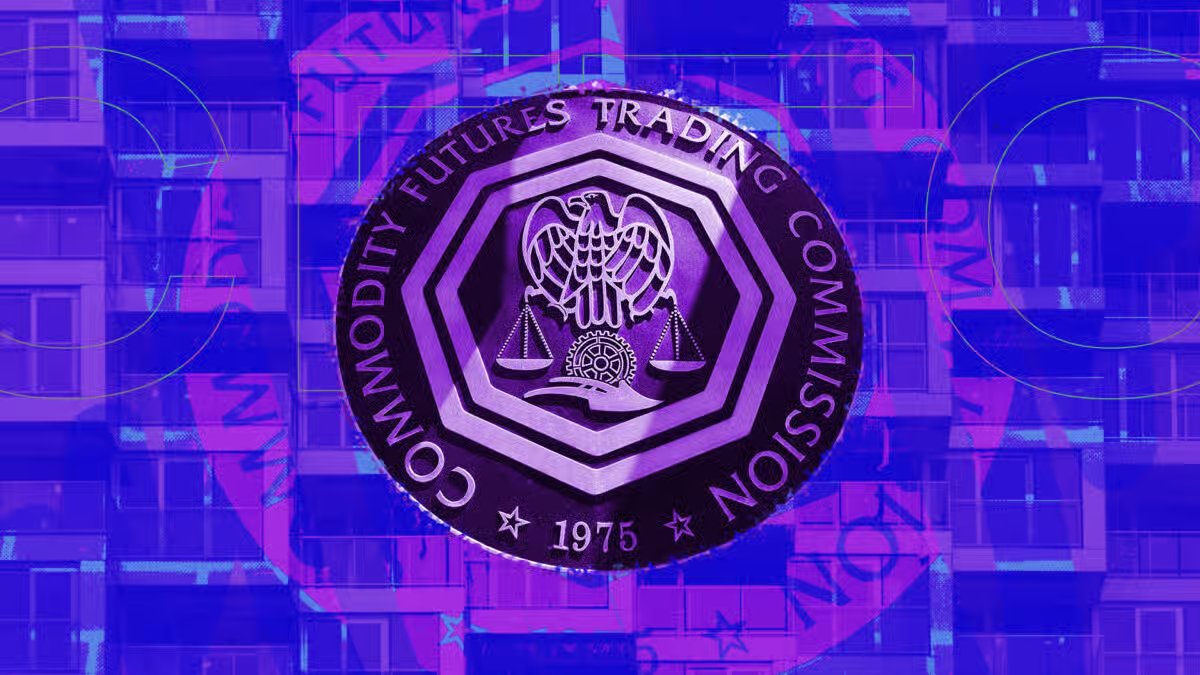
Kalshi and PredictIt both sit inside full CFTC regulation today – Kalshi as a Designated Contract Market, PredictIt as of its 2025 court win and transition away from its old academic no-action letter. Robinhood’s event contracts inherit that same regulatory umbrella indirectly, since it’s routing trades through Kalshi’s and ForecastEx’s regulated exchanges rather than running its own unregulated venue. Regulators are paying close enough attention to this whole category that the CFTC has signaled new federal rules are coming specifically for platforms like Robinhood and Kalshi.
Polymarket is the outlier here. Its QCEX acquisition is a real move toward CFTC compliance, but the team has not finished that work yet. The platform has blocked U.S. users during parts of this shift. Myriad sits outside the CFTC framework entirely. It runs as a decentralized, on-chain protocol, not a registered exchange. That puts it in a very different position than the other four.
If clear regulation matters most to you, Kalshi, PredictIt, and Robinhood (through its Kalshi/ForecastEx routing) give you the most right now. Polymarket is working toward it. Myriad is not trying to fit inside that framework at all. It relies on on-chain transparency instead of CFTC oversight. That is a different kind of safety net, not a worse one by default. But you should understand the difference before putting money in.
Markets and trading
Kalshi leans hard into sports – 80% of its volume since mid-2024, with sports, politics, and crypto combined making up 91%. Robinhood’s markets mirror a subset of that, since it’s largely surfacing Kalshi and ForecastEx contracts inside its own app. Polymarket spreads wider – sports is only 39% of its volume, with the rest split across politics, crypto, entertainment, and global events most other platforms don’t touch.
PredictIt stays narrow on purpose. It only lists U.S. political markets – primary races, general elections, control of Congress, cabinet appointments – and that narrowness is the point for traders who specifically want the deepest, longest-running political contracts available anywhere. Myriad goes the other direction on format: it lists markets on crypto prices, macro events, politics, sports, entertainment, and pop culture, but the differentiator isn’t category breadth, it’s where you encounter the market – inside an article or social post via browser extension, not on a standalone site you have to remember to visit.
New to how any of these markets actually price an outcome? Our order books and liquidity module covers order books, spreads, and how a contract price becomes an implied probability, which applies whether you’re trading a regulated Kalshi contract or an on-chain Myriad market.
Fees
| Fee type | Kalshi | Polymarket | PredictIt | Myriad | Robinhood |
|---|---|---|---|---|---|
| Trading fee | Disclosed per-contract fee | No direct trading fee, gas costs apply | 10% fee on profits | Protocol/network fee, varies by chain | Flat $0.01 per contract, per side |
| Withdrawal | Free ACH (1-3 business days) | Free to wallet, gas only | 5% fee on withdrawals | Network gas only | Standard Robinhood transfer terms |
| Position limit | Market-dependent | Market-dependent | $3,500 per contract | Not publicly disclosed | Market-dependent |
PredictIt’s fee structure is the most expensive on this list in relative terms – a 10% cut of profits plus a 5% withdrawal fee adds up fast for anyone trading actively rather than holding one position to resolution. That cost has always been part of the trade-off for access to the deepest political-market history in the country, and it hasn’t changed with the 2025 regulatory shift.
Robinhood’s flat $0.01-per-contract-per-side fee is easy to reason about on a single trade, but it’s still a real cost that scales with how many contracts you buy, not with your position size in dollars. Kalshi’s disclosed per-contract fee works similarly – transparent, but not free. Polymarket and Myriad avoid a direct platform cut, but neither is actually free to trade: gas costs and, for Myriad, whatever fee structure the specific chain it’s running on charges, both apply per transaction.
User experience
Kalshi and Robinhood are the two easiest on-ramps for someone who has never touched a prediction market or a crypto wallet. Kalshi’s signup mirrors opening a brokerage account – you enter your Social Security number, link a bank, fund with dollars, and finish in minutes. Robinhood goes a step further for existing users: if you already have a Robinhood account, prediction markets are just another tab, not a new signup at all.
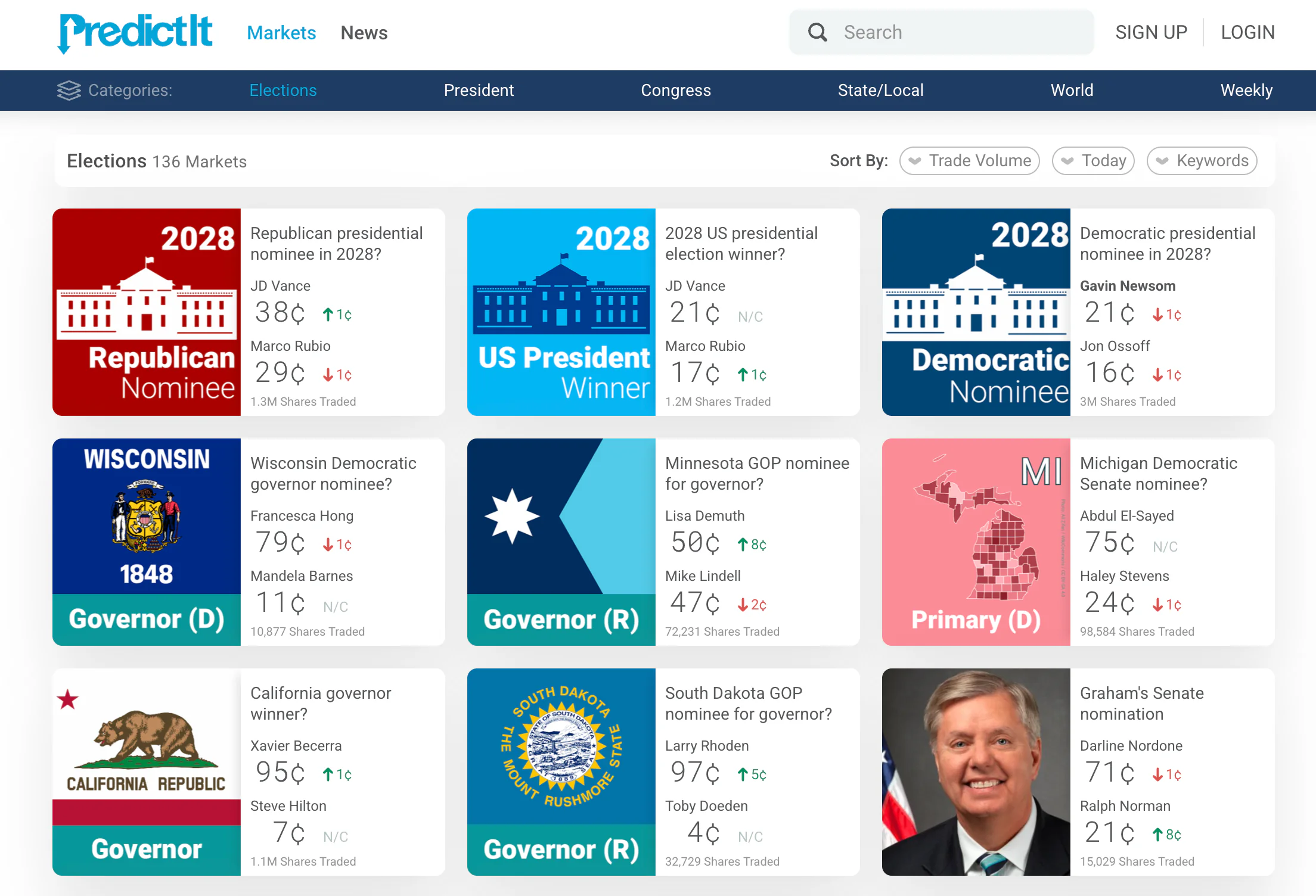
PredictIt’s interface looks older than the newer platforms, but its narrow focus on political markets means less to learn. You are not scrolling through categories you do not care about. Polymarket still expects some comfort with crypto wallets and USDC funding, though card options are closing that gap. Myriad is the most unusual of the five. Instead of a standalone app, it works as a browser extension that shows markets inside content you already read. That removes the “remember to check the app” problem, but you have to trust a fairly new way of trading.
Automation and tools
Kalshi, Polymarket, and PredictIt all expose APIs suitable for bots, alerts, and analytics. Kalshi’s sits inside its regulated framework, so automated trading through it carries the same compliance posture as manual trading. Polymarket’s on-chain, publicly verifiable order book has produced the largest third-party ecosystem of the five – whale-tracking dashboards, copy-trading tools, and portfolio trackers built directly off its blockchain data.
Robinhood, as a broker rather than an exchange for most of its listings, doesn’t currently offer the kind of open API access that power users building bots typically want – you’re trading inside its app, not against a public order book you can build tooling around. Myriad’s multi-chain, protocol-level architecture is developer-accessible in a different sense: its documentation targets builders who want to embed markets into their own content, not necessarily traders running independent bots.
If you’re evaluating tools that plug into any of these platforms, our tools directory covers whale tracking, portfolio dashboards, and copy trading options, organized by category so you can see what’s actually available before picking a platform to build around.
Geographic availability
Kalshi, PredictIt, and Robinhood all require U.S. identity verification and are built around U.S. users specifically. Polymarket has historically been more accessible internationally but has restricted U.S. access during parts of its regulatory transition – routing around that with a VPN generally violates its terms even where it’s technically possible. Myriad’s on-chain, wallet-based model makes it accessible from more places by default, though local rules on crypto and prediction markets vary enough that “accessible” doesn’t automatically mean “compliant with your jurisdiction’s laws.”

All five platforms’ geographic rules are moving targets right now, especially with federal regulators signaling new rules for this category broadly. Check each platform’s current terms directly before funding an account rather than trusting a comparison article, including this one, that may be a few months old by the time you read it.
Who each platform actually fits
If you’re brand new to prediction markets and already use Robinhood, start there. You skip a signup entirely, and the contracts you’re trading run through the same regulated infrastructure as Kalshi’s own listings.
If you’re new and don’t have a Robinhood account, Kalshi is the cleanest standalone option – dollar funding, a familiar signup, and full CFTC oversight remove every obstacle except the actual trading decision.
If political markets are specifically your focus, PredictIt’s post-2025 regulatory standing and its $3,500 position limit make it worth the higher fee structure, especially if you want the deepest historical data on U.S. elections available anywhere.
If you want the widest range of markets and don’t mind crypto, Polymarket remains the broadest single destination, and its larger third-party tool ecosystem is a real advantage if you’re building anything on top of it.
If you want prediction markets without a dedicated app or a new habit to build, Myriad’s embedded, in-feed model fits casual engagement better than any of the other four – you’re betting on the headline you were already reading, not opening a separate tab for it.
If you’re a researcher or journalist using prices as a signal, Kalshi and Robinhood together are the strongest read on U.S. sports and political sentiment specifically, PredictIt gives you the longest political time series, and Polymarket is the better source once your question moves outside U.S. borders.

What none of them do well
None of these five platforms is particularly good at teaching you how to think about a market before you trade real money on it. All of them are optimized to get you to a trade quickly, not to explain implied probability, position sizing, or when a market simply isn’t worth entering. That gap is exactly what independent, platform-neutral education exists to fill, and it’s true across every platform on this list regardless of how it’s regulated or built.
Resolution disputes are also an industry-wide problem, not a single-platform one. When a real-world event’s outcome is genuinely ambiguous, the process for settling a contract can feel opaque no matter which of these five you’re using. Recent high-stakes losses on Polymarket during major sporting events are a useful reminder that even experienced traders get burned by overconfidence in outcomes that looked safe right up until they weren’t – a risk that doesn’t disappear just because a platform is fully regulated.
Kalshi vs Polymarket and the rest: side-by-side verdict
Choose Kalshi if you want a standalone, fully regulated, dollar-funded platform with deep sports and political markets and no crypto learning curve.
Choose Polymarket if you’re comfortable with crypto and want the broadest range of global markets, backed by the largest third-party tool ecosystem of the five.
Choose PredictIt if political markets are your main interest and you want the longest U.S. track record, and you’re fine paying more in fees for it.
Choose Myriad if you want prediction markets that show up inside content you already read, without a dedicated app or a new daily habit.
Choose Robinhood if you already have an account and want the lowest-friction possible way to place a first prediction market trade – just know you’re trading through Kalshi’s and ForecastEx’s rails, not a Robinhood-run exchange, at least until its own MIAXdx-based exchange launches later in 2026.
None of these are mutually exclusive. A lot of active traders end up running two or three accounts once they know which market categories and which trade-offs – fees, regulation, breadth – actually matter to them.
Frequently asked questions
Robinhood is the fastest start if you already have an account – no new signup needed. Without one, Kalshi gives you the cleanest standalone option: dollar funding, a familiar brokerage-style signup, and no crypto wallet required.
Not yet, for most listings. Robinhood currently routes event-contract trades through Kalshi’s and ForecastEx’s regulated exchanges and charges a flat $0.01 per contract per side. Robinhood and Susquehanna are building their own exchange through a joint venture, targeting a 2026 launch.
PredictIt won a court challenge against the CFTC in July 2025 and moved to full CFTC registration, up from its old university-affiliated no-action letter. Its position limit rose from $850 to $3,500 per contract, and the CFTC removed the old 5,000-trader cap.
Polymarket, by a clear margin – politics, crypto, entertainment, and global events beyond U.S. sports and politics. PredictIt is the narrowest by design, covering only U.S. political markets.
Myriad embeds prediction markets directly into articles, social posts, and newsletters through a browser extension, rather than requiring a visit to a dedicated app. It also runs on multiple blockchains and sits outside CFTC regulation entirely.
Yes. PredictIt charges 10% of profits plus a 5% withdrawal fee, which is higher in relative terms than Kalshi’s disclosed per-contract fee or Robinhood’s flat $0.01-per-contract charge.
Yes, and many active traders do. A common pattern is starting with Kalshi or Robinhood to learn the mechanics, then adding Polymarket or PredictIt once you know which market categories you actually want.
Polymarket blocked U.S. users during parts of its regulatory transition. Its $112 million QCEX acquisition is a step toward compliance , but the process isn’t complete. Check current terms before signing up if you’re in the U.S.
Polymarket’s public, on-chain data has produced the largest ecosystem of third-party bots, whale trackers, and analytics tools. Kalshi’s API is solid but has a smaller surrounding tool ecosystem; Robinhood currently offers little of this kind of open access.
Regulatory uncertainty for Polymarket’s U.S. users, a new and untested trust model for Myriad, and – across all five – resolution disputes on genuinely ambiguous events plus the temptation to overtrade on outcomes that look safer than they are.