
1.4 Understanding Risk — The Honest Truth
Key Takeaways
- Most prediction market traders lose money. ~70% of all Polymarket addresses record net losses. The median retail return is −8% — worse than sports betting
- Profits are radically concentrated: fewer than 0.04% of wallets capture over 70% of all platform gains. You are almost certainly not in that group yet
- Prediction markets carry at least six distinct risk types — capital, liquidity, platform, resolution, regulatory, and psychological — and you need to understand all of them before committing real money
- The single most important skill in prediction trading isn’t finding good trades — it’s sizing your positions correctly so that inevitable losses don’t destroy your ability to keep trading
- If you remember only one thing from this entire school: never trade with money you cannot afford to lose completely
Scope: This module covers the risks of prediction market trading — statistical reality, structural dangers, and psychological traps. It does not cover risk mitigation strategies in depth (that’s Module 2.4: Position Sizing & Bankroll Management) or how to identify favorable risk/reward setups (that’s Level 3). This module is about seeing clearly before you start.
The Numbers Most People Don’t Want to Show You
We’re going to open this module with the data that most prediction market platforms, influencers, and “how to trade” guides would rather you not see. We show it because we believe you deserve to make informed decisions, and because understanding these numbers is the only real foundation for long-term success.
70% of Traders Lose Money
Comprehensive analysis of approximately 1.7 million Polymarket wallet addresses reveals that roughly 70% of all users record net losses on the platform (Citizens JMP Securities – Prediction Markets Report, 2026).
This isn’t a quirk of prediction markets. It’s the structural norm across nearly all speculative trading environments — from forex to options to crypto day trading. But prediction markets have unique characteristics that make the losses especially concentrated for small accounts.
Small Accounts Get Crushed
The data shows a brutal relationship between account size and survival:
| Account Size | Median Return |
|---|---|
| Under $100 | −26.8% |
| $100–$1,000 | −12.4% |
| $1,000–$10,000 | −5.1% |
| $10,000–$100,000 | −1.3% |
| $100,000–$500,000 | +0.8% |
| Over $500,000 | +2.6% |
Read that table carefully. Traders with less than $100 in their accounts lose more than a quarter of their money on average. Meanwhile, traders with over $500,000 — the “sharp” money, the professionals, the quantitative syndicates — are the only cohort consistently making money.
Why? Because well-capitalized traders can:
- Absorb short-term variance without being forced out of positions
- Execute sophisticated strategies (arbitrage, bias exploitation) that require significant capital to be profitable after fees
- Deploy proprietary quantitative models and API-based execution
- Make markets (provide liquidity) and earn the spread instead of paying it
If you’re starting with $50–$500, you are the one whose money flows to these participants. That’s not an insult — it’s a mathematical fact about how markets work. Understanding it is the first step to eventually changing your position in that hierarchy.
Worse Than Sports Betting
Here’s a comparison that should give you pause:
Between July 2025 and March 2026, the median retail prediction market user recorded a −8% return. Over the same period, the median retail sports bettor recorded a −5% return (Citizens JMP Securities, 2026).
Prediction markets are harder than sports betting for retail participants. Why?
- No house edge transparency. In sports betting, you know the vig is ~4.5%. In prediction markets, the costs (spread + fees + adverse selection) are invisible and variable
- Adverse selection is more severe. In prediction markets, your counterparty may be a geopolitical insider, a quantitative hedge fund, or someone with material non-public information — not just another sports fan
- Binary settlement amplifies mistakes. Every wrong prediction loses 100% of the position. There’s no partial payout, no spread covering, no point-differential cushion
⚠️ We’re not saying this to discourage you. We’re saying it because every other source in this space — platforms, influencers, social media “traders” — has a financial incentive to downplay these numbers. We don’t. If you trade prediction markets, you should do so with full knowledge of the statistical landscape.
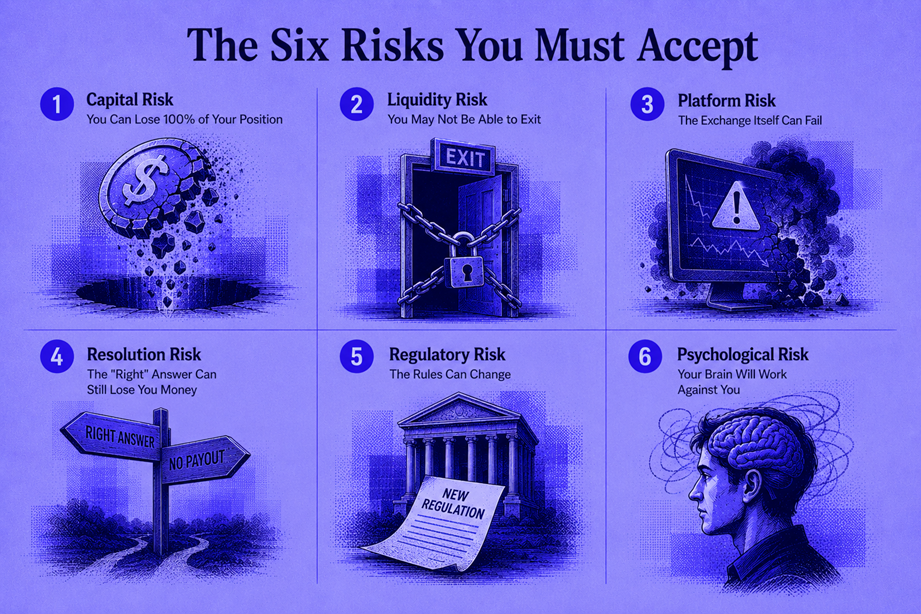
The Six Risks You Must Accept
Every prediction market trade exposes you to at least six categories of risk. Most beginner education only mentions the first one. That’s not good enough.
1. Capital Risk — You Can Lose 100% of Your Position
This is the most obvious risk, but it bears explicit statement because prediction markets are unlike almost any other financial instrument in this regard.
If you buy shares of Apple stock and the company has a bad quarter, maybe the stock drops 10%. It would take a catastrophic, near-impossible event for you to lose everything.
In prediction markets, losing everything is the normal outcome for the losing side. Every contract either resolves to $1.00 or $0.00. There is no middle ground. If you buy “Yes” at $0.70 and the event doesn’t happen, you lose $0.70 per contract — 100% of your investment. This isn’t a tail risk. It’s the standard settlement mechanic.
What this means in practice: You should never put a significant portion of your net worth into any single prediction market position. Every trade must be sized with the assumption that you could lose the entire amount.
2. Liquidity Risk — You May Not Be Able to Exit
In Module 1.3, we explained that you can sell your contracts before resolution. That’s true — if someone is willing to buy them from you.
In low-liquidity markets, the bid-ask spread can widen dramatically, especially as the resolution date approaches. You might hold “Yes” contracts worth $0.60 based on the last trade, but the current bid is only $0.45. If you need to exit, you’re taking a massive haircut.
Worst case: In very thin markets, there may be no bids at all. Your contracts become effectively illiquid — you’re locked in until resolution, whether you like it or not.
How to mitigate: Stick to markets with visible order book depth. Check how many contracts are on the bid side before you enter. As a rule, if you can’t sell at least 80% of your position size within 3 cents of the current price, the market is too thin for you.
3. Platform Risk — The Exchange Itself Can Fail
Prediction markets are younger and less regulated than traditional financial exchanges. Platform risk is real and has happened:
- Intrade (2013): Once the world’s leading prediction market, Intrade collapsed after CFTC enforcement action and the discovery of $700,000 in “financial irregularities.” Users lost access to funds
- Augur (2017–2020): The first decentralized prediction market suffered from prohibitively low liquidity, poor UX, and an oracle system that was too slow and expensive to be practical. While user funds weren’t lost, the platform became functionally unusable
- Smart contract risk (ongoing): DeFi platforms like Polymarket and Limitless rely on smart contracts. While Polymarket’s contracts have been professionally audited, no code is bug-free. A critical vulnerability could theoretically freeze or drain user funds
On crypto platforms specifically: Your funds sit in a smart contract on a blockchain. You rely on the integrity of the smart contract code, the oracle system, and the underlying blockchain network. This is fundamentally different from a regulated brokerage where deposits are SIPC-insured.
On regulated platforms: Kalshi is CFTC-regulated, which provides some protections. But even regulated platforms can face enforcement actions, operational failures, or financial difficulties. The State of Arizona filed criminal charges against Kalshi in 2025 — a reminder that regulatory approval in one jurisdiction doesn’t guarantee smooth operations everywhere.
4. Resolution Risk — The “Right” Answer Can Still Lose You Money
This is the most underappreciated risk in prediction markets. Resolution disputes can turn what should be a clear win into a total loss.
Real examples:
The “Zelenskyy Suit” market (Polymarket, 2024): A market asked whether Ukrainian President Zelenskyy would wear a suit to a specific event. The market initially resolved to “Yes.” Traders who had bought “Yes” celebrated. Then the resolution was disputed through UMA’s oracle system, and the resolution was flipped to “No” via token-holder vote. Traders who were factually correct about the real-world event lost money because the oracle vote went against them.
The “Trump says China” market (Polymarket): A market asked whether Trump would say the word “China” during a specific address. Trump literally said “China.” The market should have resolved to “Yes.” But Polymarket issued a retroactive clarification about the context in which the word needed to be spoken, and the market resolved to “No.”
These aren’t theoretical edge cases. They happen regularly on decentralized platforms where resolution relies on oracle votes rather than predetermined authoritative sources. Even on Kalshi, where resolution sources are predefined, ambiguity in the question wording can lead to outcomes that feel unfair to traders who thought they understood the rules.
How to mitigate: Before trading any market, read the full resolution criteria — not just the headline question. Look for:
- Specific sources named (e.g., “Resolves based on Bureau of Labor Statistics report”)
- Clear definitions of key terms (e.g., “a suit” vs. “formal attire”)
- Time zone specifications and deadline clarity
- Any clauses about “Predictionist discretion” or similar subjective override language
If the resolution criteria seem ambiguous, skip the market. There are always other trades.
5. Regulatory Risk — The Rules Can Change
Prediction markets exist in a rapidly evolving legal landscape, and what’s legal today may not be legal tomorrow.
Current regulatory reality (as of April 2026):
- United States: CFTC-regulated platforms (Kalshi, ForecastEx) are legal for U.S. users. Polymarket is officially geoblocked after a 2022 CFTC enforcement action and $1.4 million settlement. Despite this, significant U.S.-based volume continues through VPN usage — which carries its own legal risks
- European Union: MiCA (Markets in Crypto-Assets) regulation is being applied to crypto prediction platforms. Compliance requirements are in flux
- Other jurisdictions: Legality varies widely. Many countries have no specific framework for prediction/event contracts, creating regulatory uncertainty
What could change:
- The CFTC could restrict more contract types on regulated platforms (they have already blocked certain political contracts in the past)
- States could individually restrict or criminalize participation (as Arizona attempted with Kalshi)
- Tax authorities could reclassify prediction market gains, increasing the effective rate
- Crypto platforms could be forced to implement KYC, altering their global accessibility
If your capital is on a platform that gets shut down or restricted, you may face delays or losses withdrawing your funds. This has happened before.
6. Psychological Risk — Your Brain Will Work Against You
This might be the most dangerous risk of all, because it’s the one you’re least likely to see in yourself.
Addiction potential. Binary outcomes with immediate resolution create a dopamine loop similar to slot machines. The “almost won” feeling on a $0.45 contract that resolves to “No” triggers the same neurochemical patterns that make gambling addictive. Prediction markets that resolve daily or weekly (crypto prices, weather events) are especially prone to this dynamic.
Revenge trading. After a loss, you feel the urge to place another trade immediately — usually larger and less carefully analyzed — to “win back” what you lost. This is the single fastest way to drain a bankroll.
Sunk cost fallacy. You bought “Yes” at $0.60 and it’s now trading at $0.30. New information strongly suggests the event won’t happen. But you’ve already “invested” $0.60, so you hold. This is irrational — the $0.60 is gone regardless. The question is: “If I had $0.30 in cash right now, would I buy this contract?” If the answer is no, you should sell.
Confirmation bias. Once you take a position, you start filtering news and data to support your view. You read bearish takes on a market where you’re short, and dismiss bullish arguments. This is human nature, and it destroys analytical objectivity.
Emotional attachment. If you’re trading on a political candidate you support, a team you love, or a company you admire, you are almost certainly overestimating the probability of the outcome you want and underestimating the alternative. The research is clear: emotional involvement degrades prediction accuracy.
💡 Self-test: After every trade, ask yourself: “Am I placing this trade because my analysis shows the market is wrong? Or because I want this outcome to happen?” If the answer is the latter, cancel the trade. You’re not investing — you’re paying for emotional entertainment, and there are cheaper ways to do that.
How Much Should You Risk?
Let’s talk about bankroll management — the most boring and most important topic in trading.
The Only Rule That Matters
Never trade with money you cannot afford to lose completely and permanently.
This isn’t a legal disclaimer. It’s practical advice based on the statistics above. If 70% of traders lose money and small accounts lose the most, you should assume your initial bankroll is tuition — the cost of learning.
Recommended Starting Bankroll
| Your Situation | Suggested Bankroll | Reasoning |
|---|---|---|
| Complete beginner, just exploring | $20–$50 | Enough to place 10–20 small trades and learn the mechanics. Expect to lose most of it |
| Interested and committed to learning | $100–$300 | Gives you room for 30–50 trades at small sizes. You’ll start seeing patterns in your wins and losses |
| Experienced speculator from other markets | $500–$1,000 | Enough to execute more sophisticated strategies. Still assume potential total loss |
What these amounts should NOT come from:
- Rent or mortgage money
- Emergency funds
- Money earmarked for bills, debt payments, or savings goals
- Borrowed money (credit cards, loans, margin)
- Money you’d feel uncomfortable telling your family you lost
Position Sizing: The 5% Rule
Once you have a bankroll, size each individual trade at no more than 5% of your total bankroll. This means:
- $100 bankroll → maximum $5 per trade
- $500 bankroll → maximum $25 per trade
- $1,000 bankroll → maximum $50 per trade
Why 5%? Because even a string of 10 consecutive losing trades (which will happen) only draws down your account by ~40%. You’re still alive. You can still trade. You can still learn.
If you’re betting 25–50% of your bankroll on single trades, one bad day can wipe you out. And once you’re wiped out, you can’t recover — you have to re-deposit, which is both financially and psychologically costly.
💡 Advanced position sizing — the Kelly Criterion and its fractional variants — is covered in Module 4.1: Position Sizing & Bankroll Management. For now, the 5% rule is the simplest way to protect yourself while learning.
Red Flags — When NOT to Trade
Knowing when not to trade is as valuable as knowing when to trade. Walk away from any market that triggers one of these red flags:
🚩 Ambiguous Resolution Criteria
If you can’t clearly articulate — in one sentence — exactly what needs to happen for the market to resolve “Yes,” don’t trade it. Ambiguity benefits insiders and experienced traders who understand the platform’s resolution norms. It hurts newcomers.
🚩 You Don’t Understand the Underlying Event
If a market is about Turkish central bank policy and you don’t follow Turkey’s monetary policy, you have no analytical edge. You’re guessing — and the people on the other side of your trade are probably not guessing.
🚩 Emotional Attachment to the Outcome
If you’d be personally happy or upset about the event outcome regardless of the trade, your emotional investment will compromise your probability estimate. Political markets are the biggest trap here — people consistently overestimate the chances of their preferred candidate, even when they know they shouldn’t.
🚩 Thin Liquidity
If the order book shows fewer than a few hundred contracts on the bid, you may not be able to exit at a reasonable price. Being “right” on a prediction but unable to realize a profit because there’s no one to sell to is a special kind of frustrating.
🚩 The Urge to “Win Back” Losses
After a losing trade, if your immediate instinct is to find another trade to recover the money, stop trading for the day. This is revenge trading — statistically, the trades placed in this emotional state have significantly worse expected value than your first trades did.
🚩 You’re Risking Money You Need
If you catch yourself thinking “if this trade wins, I can pay my rent” — close the app. You’ve crossed from informed speculation into desperation, and the probabilities are overwhelmingly against you.
A Note on Insider Trading
We need to address something that many prediction market resources avoid discussing: insider trading is rampant in prediction markets, and it directly affects your risk as a retail participant.
In early 2026, anonymous Polymarket accounts front-ran the U.S. apprehension of Venezuelan President Nicolás Maduro — purchasing $32,000 in contracts and netting a $400,000 return hours before the news became public (Source: Protos — Insider Trading on Polymarket). Similar front-running occurred before Israeli military strikes on Iran, where accounts netted $150,000 on perfectly timed trades.
Unlike stock markets, where insider trading is a federal crime enforced by the SEC, prediction markets, particularly decentralized ones, have no effective enforcement mechanism against participants trading on material non-public information. This means:
- On any given trade, your counterparty might know something you don’t — and something no amount of public research would reveal
- Political and geopolitical markets are the most vulnerable to this dynamic
- Markets that move sharply and unexpectedly without a clear public catalyst should make you cautious, not excited
This doesn’t mean you can’t trade these markets profitably. It means you should factor adverse selection risk into your expected value calculations. If you’re trading a market where insiders are likely active (geopolitical military actions, government policy decisions), your analytical edge needs to be larger to compensate for the probability that you’re trading against someone with better information.
What You Learned
In this module, you learned:
- ~70% of prediction market traders lose money, and the median retail return (−8%) is worse than sports betting
- Profits are radically concentrated — 0.04% of wallets capture 70%+ of all gains. The market is a wealth transfer mechanism from unsophisticated to sophisticated participants
- Small accounts get crushed (−26.8% for accounts under $100) while large accounts profit (+2.6% for accounts over $500K)
- Six distinct risk categories exist: capital, liquidity, platform, resolution, regulatory, and psychological — and you need to manage all of them
- Position sizing is your primary defense — the 5% rule protects against the inevitable losing streaks
- Knowing when NOT to trade is as important as knowing when to trade — six red flags to watch for
- Insider trading is real and unregulated in most prediction markets, creating adverse selection risk for retail participants
What’s Next
If you’ve read this module and you still want to trade prediction markets, good. You’re entering with clear eyes, which already puts you ahead of the majority.
The next module helps you choose the right platform for your specific situation — geography, funding method, risk tolerance, and trading goals. Where you trade matters almost as much as how you trade.
→ Module 1.5: Choosing Your Platform
🎯 Try This Now: Before you place your next trade, do this exercise: Write down the maximum amount of money you’re comfortable losing completely on prediction markets over the next 6 months. Not “I hope to make back” — the amount you can lose and it won’t change your life. That number is your bankroll. Now divide it by 20. That’s your maximum position size per trade. If that number feels too small to be interesting, that’s an important signal — it means your true comfortable bankroll is smaller than you think.
Predictionist School is a free educational resource from Predictionist.com. We may earn referral commissions from platforms we recommend — see our disclosure policy for details. This content is for educational purposes only and does not constitute financial advice.