1.5 Choosing Your Platform
Key Takeaways
- There is no single “best” platform — the right choice depends on your location, funding method, market interests, and risk tolerance
- Kalshi is the best starting point for U.S. residents who want CFTC regulation and fiat deposits
- Polymarket is the best starting point for non-U.S. users or crypto-comfortable traders who want the widest market selection and deepest liquidity
- Fees, liquidity, and resolution mechanics vary dramatically across platforms — and these differences directly impact your profitability
- Many experienced traders use multiple platforms simultaneously to access different markets and capture cross-platform opportunities
Scope: This module helps you choose where to trade. It does not teach you how to trade (that was Module 1.3) or what to trade (that’s Level 3). For deep dives into each platform, see the individual reviews in our Platform Directory.
The Decision Framework
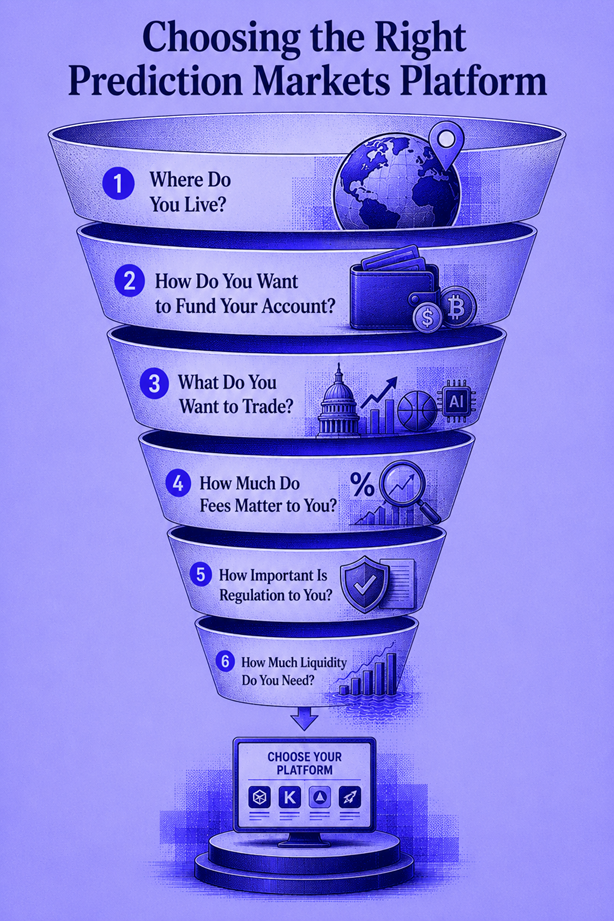
Choosing a platform comes down to six factors. Work through them in order — the first two will eliminate most options, and the remaining four will narrow you to a final choice.
Factor 1: Where Do You Live?
This is the single biggest filter. Regulation determines which platforms you can legally access.
| Your Location | Platforms Available |
|---|---|
| United States | Kalshi ✅ · ForecastEx (Interactive Brokers) ✅ · Robinhood (event contracts) ✅ · FanDuel Predicts ✅ · Polymarket ❌ (geoblocked) |
| European Union | Polymarket ✅ · Limitless ✅ · Kalshi ❌ (U.S. only) |
| United Kingdom | Polymarket ✅ · Limitless ✅ · Kalshi ❌ |
| Canada | Polymarket ✅ · Limitless ✅ · Kalshi ❌ |
| Asia-Pacific | Polymarket ✅ · Limitless ✅ · Kalshi ❌ |
| Rest of World | Polymarket ✅ (most countries) · Limitless ✅ · Local restrictions may apply |
⚠️ A note on VPNs: Some U.S.-based traders access Polymarket via VPN. This violates Polymarket’s terms of service and may carry regulatory risk — Polymarket settled with the CFTC for $1.4 million in 2022 precisely over unauthorized U.S. access. We don’t recommend this approach, but we acknowledge it happens at significant volume. If you choose this route, understand the risks (see Module 1.4).
Factor 2: How Do You Want to Fund Your Account?
This is the second practical filter. Some platforms accept bank transfers and credit cards; others require cryptocurrency.
| Funding Method | Compatible Platforms |
|---|---|
| Bank account (ACH) | Kalshi, Robinhood, FanDuel |
| Debit/credit card | Kalshi, Polymarket (via onramp), FanDuel |
| Wire transfer | Kalshi, ForecastEx |
| Existing brokerage balance | Robinhood, ForecastEx (IBKR) |
| USDC (stablecoin) | Polymarket, Limitless |
| Other crypto → USDC | Polymarket (via bridge), Limitless |
If you don’t own any cryptocurrency and don’t want to learn about wallets, stablecoins, and bridging — stick with fiat platforms. The learning curve for crypto adds friction that distracts from learning prediction markets themselves.
If you’re already comfortable with crypto wallets and USDC — crypto platforms offer lower fees, wider market selection, and global access.
Factor 3: What Do You Want to Trade?
Different platforms specialize in different event categories:
| Category | Best Platform(s) | Why |
|---|---|---|
| U.S. Politics | Kalshi, Polymarket | Both have deep liquidity; Kalshi is regulated for U.S. political contracts |
| Global Geopolitics | Polymarket | Broadest coverage of international events, conflicts, diplomacy |
| Economics (Fed, GDP, Jobs) | Kalshi | Clean resolution via government data sources (BLS, BEA). Deep liquidity on Fed markets |
| Crypto Prices | Polymarket, Limitless | Native crypto audience, 24/7 trading, rapid resolution |
| Weather / Climate | Kalshi | Pioneered structured weather contracts with NOAA-based resolution |
| Culture / Entertainment | Polymarket | Awards shows, viral events, celebrity-driven markets |
| Sports | FanDuel Predicts | Sports-focused user base, integrated with existing FanDuel accounts |
| Science / Tech | Polymarket, Kalshi | Overlapping coverage; check both for specific markets |
| Play-Money / Practice | Manifold Markets | Free to play, great for testing forecasting skills without financial risk |
💡 If you’re unsure what you want to trade: Start with Kalshi (U.S.) or Polymarket (global). Both have the widest selection in their respective categories. You can always add a second platform later.
Factor 4: How Much Do Fees Matter to You?
If you plan to trade frequently or with a defined strategy, fee structure becomes critical. A few percentage points of friction per trade compounds into massive differences over hundreds of trades.
Here’s the full fee comparison:
| Platform | Trading Fee | Withdrawal Fee | Effective Total Friction | Best For |
|---|---|---|---|---|
| Polymarket | None (spread-embedded) | Gas fees (~$0.01–$0.10 on Polygon) | Very low (<1%) | High-frequency traders, strategists |
| Kalshi | Variable per contract | Free (ACH) | Low-medium (1–3%) | Casual to active traders |
| ForecastEx | Exchange fee | Standard IBKR fees | Low (1–2%) | Institutional, yield-focused |
| Robinhood | Embedded in spread | N/A (stays in Robinhood) | Low-medium (~2%) | Existing Robinhood users |
| FanDuel Predicts | 1% (capped at $5) | Standard FanDuel terms | Low (1%) | Sports-adjacent casual traders |
| Limitless | 0.03%–3% (dynamic) | Gas fees on Base | Variable | DeFi-native traders |
| Manifold | N/A (play money) | 1000:1 Mana→USD conversion | N/A | Practice, forecasting skill development |
Rule of thumb:
- Trading < 5 times/month → fees barely matter. Pick the platform with the best market selection
- Trading 5–20 times/month → low-fee platforms save you real money. Polymarket or Kalshi preferred
- Trading 20+ times/month → you are effectively a professional. Fee structure is a primary platform selection criterion. Polymarket’s near-zero fees become essential
Factor 5: How Important Is Regulation to You?
This is partly a risk tolerance question and partly a philosophical one.
| Regulation Level | Platform | What You Get | What You Give Up |
|---|---|---|---|
| CFTC-regulated | Kalshi, ForecastEx | Predefined resolution sources, regulatory oversight, clearer legal standing, straightforward tax reporting | Fewer market types, U.S.-only access, some contract restrictions |
| Partially regulated | Robinhood, FanDuel | Familiar interfaces, existing account integration, FINRA/state-level protections | Limited event selection, embedded fees |
| Unregulated / decentralized | Polymarket, Limitless | Maximum market selection, global access, near-zero fees, full transparency (on-chain) | Oracle-based resolution (dispute risk), no deposit insurance, complex tax reporting, smart contract risk |
| Play-money | Manifold | Zero financial risk, pure forecasting practice | No real monetary returns |
Our honest assessment: For most U.S.-based beginners, the regulatory protections of Kalshi outweigh the broader market selection of Polymarket. For non-U.S. traders, Polymarket offers the strongest combination of liquidity, market breadth, and low fees — but you should understand you’re trading on an unregulated, decentralized platform with all the risks that entails (see Module 1.4).
Factor 6: How Much Liquidity Do You Need?
Liquidity determines how easily you can enter and exit positions at favorable prices. For most beginners making small trades (<$100), liquidity isn’t a concern on any major platform. But as your position sizes grow, it matters — a lot.
| Platform | Monthly Volume (March 2026) | Typical Spread (major markets) | Liquidity Rating |
|---|---|---|---|
| Polymarket | $10B+ | $0.01–$0.02 | ⭐⭐⭐⭐⭐ |
| Kalshi | $12B+ | $0.02–$0.04 | ⭐⭐⭐⭐⭐ |
| ForecastEx | Not publicly disclosed | $0.02–$0.05 | ⭐⭐⭐ |
| Robinhood | Not publicly disclosed | ~$0.03–$0.05 | ⭐⭐⭐ |
| FanDuel Predicts | Not publicly disclosed | ~$0.03–$0.06 | ⭐⭐⭐ |
| Limitless | ~$100M+ | $0.03–$0.08 | ⭐⭐ |
| Manifold | N/A (play money) | N/A | N/A |
(Volume sources: Kalshi monthly report March 2026; Polymarket – Dune Analytics dashboards)
💡 Important nuance: These numbers are platform-wide averages. Individual markets can vary wildly. A high-profile U.S. election market on Polymarket might have millions of dollars of liquidity, while a niche science market on the same platform might have a $0.10+ spread and minimal depth. Always check the order book on the specific market you want to trade.
Quick-Start Recommendations
Based on the framework above, here are our recommendations for the most common situations:
🇺🇸 U.S. Resident, New to Prediction Markets
Start with → Kalshi
- Regulated, familiar brokerage-style interface
- Fund with your bank account
- Best coverage for economic and political events
- No crypto knowledge required
When to add a second platform: Once you’re comfortable with the mechanics and want access to more global markets, consider exploring Polymarket (understanding the regulatory considerations for U.S. users).
🌍 Non-U.S. Resident, New to Prediction Markets
Start with → Polymarket
- World’s largest prediction market by user base
- Widest market selection across all categories
- Lowest effective fees
- Can fund with credit card (no prior crypto needed)
When to add a second platform: If you want practice without risking real money, try Manifold Markets alongside Polymarket to develop your forecasting skills.
🇺🇸 U.S. Resident, Already Has a Robinhood / FanDuel Account
Start with → Your existing platform
- Zero setup friction — you can trade event contracts today
- Familiar interface reduces learning curve
- Good for exploring whether prediction markets interest you
When to switch: If you find you enjoy prediction trading and want deeper coverage, more market types, and a dedicated platform experience, move to Kalshi for your primary trading.
💰 Experienced Investor / Already on Interactive Brokers
Start with → ForecastEx (via IBKR)
- Earns yield on collateralized positions — unique advantage
- Fully CFTC-regulated
- Integrates with your existing IBKR workflow
- Best for treating prediction markets as one allocation within a broader portfolio
🧪 Just Curious / Want to Practice First
Start with → Manifold Markets
- Completely free — uses play money (“Mana”)
- Create your own markets on any topic
- Large, active community of rationalists and forecasters
- Great for learning price discovery and developing calibration skills
- No financial risk whatsoever
When to move to real money: When you’ve practiced for a few weeks, tracked your accuracy, and feel confident you understand the mechanics — not the strategy, just the mechanics — of how markets work.
Multi-Platform Strategy
As you gain experience, you’ll likely end up on multiple platforms. Here’s why experienced traders do this:
Broader Market Access
No single platform covers every event type. Kalshi excels at economic indicators; Polymarket has unmatched global geopolitics coverage; FanDuel has sports. Having accounts on 2–3 platforms gives you access to the full universe of prediction markets.
Cross-Platform Price Comparison
The same event can be priced differently across platforms. Checking prices on multiple platforms before trading ensures you’re getting the best price — and in some cases, the difference is large enough to create arbitrage opportunities.
📍 Want to compare prices across platforms before trading? → Arbitrage Tools — we review scanners like ArbBets, Eventarb, and Prediction Hunt that monitor prices across platforms in real time.
Fee Optimization
If the same market exists on both Kalshi (1–3% fees) and Polymarket (<1% fees), and you have accounts on both, you should trade where the total cost (spread + fees) is lower. This is the simplest form of trading edge — and it requires nothing more than checking two platforms before clicking “buy.”
Platform Comparison: At a Glance
For quick reference, here’s the master comparison:
| Polymarket | Kalshi | ForecastEx | Robinhood | FanDuel | Limitless | Manifold | |
|---|---|---|---|---|---|---|---|
| Access | Global (excl. U.S.) | U.S. only | U.S. only | U.S. only | U.S. (select states) | Global | Global |
| Regulation | None (decentralized) | CFTC | CFTC | FINRA | State gaming | None (decentralized) | None |
| Funding | USDC / card | Bank / card | IBKR balance | Robinhood balance | FanDuel balance | USDC | Free |
| Fees | <1% | 1–3% | 1–2% | ~2% | 1% (cap $5) | 0.03–3% | N/A |
| Markets | Broadest | Politics, econ, weather | Economics, politics | Limited | Sports, politics | Growing | User-created |
| Resolution | UMA oracle | Predefined sources | Predefined sources | Via Kalshi | Via ForecastEx | Decentralized | Community |
| Liquidity | ⭐⭐⭐⭐⭐ | ⭐⭐⭐⭐⭐ | ⭐⭐⭐ | ⭐⭐⭐ | ⭐⭐⭐ | ⭐⭐ | N/A |
| Yield on collateral | No | No | ✅ Yes | No | No | No | N/A |
| Mobile app | Web (PWA) | ✅ iOS/Android | Via IBKR app | ✅ Robinhood app | ✅ FanDuel app | Web | Web |
📍 For detailed reviews of each platform — including signup walkthroughs, detailed fee breakdowns, pros/cons, and our honest assessment — see the Platform Directory.
What You Learned
In this module, you learned:
- Six factors determine your best platform: location, funding method, market interests, fee sensitivity, regulation preference, and liquidity needs
- U.S. residents should start with Kalshi; non-U.S. residents should start with Polymarket — and both can add platforms over time
- Fees range from near-zero (Polymarket) to 20%+ (legacy PredictIt) — and this directly impacts whether your strategies can be profitable
- Regulation provides protections but limits market selection — it’s a tradeoff, not a clear “better” option
- Experienced traders use multiple platforms for broader access, price comparison, and fee optimization
- Manifold Markets is the ideal risk-free practice environment for beginners who want to learn forecasting before committing real money
What’s Next
Congratulations — you’ve completed Level 1: Fundamentals. 🎓
You now understand what prediction markets are, how pricing works, how to place a trade, the real risks involved, and which platform to use. You have enough knowledge to start trading safely and intelligently with small amounts.
Level 2 goes deeper into the mechanics of prediction trading — order books, liquidity, multi-outcome markets, position sizing with the Kelly Criterion, and the tax/regulatory landscape. These modules separate casual participants from serious, informed traders.
→ Level 2: Mechanics — Module 2.1: Reading the Order Book
🎯 Try This Now: Based on the decision framework above, identify the one platform that’s right for you. Open an account if you haven’t already (see Module 1.3 for the setup walkthrough). Then browse the market categories. Find three markets that interest you and where you have a genuine opinion. Write down the current prices and your probability estimates. Don’t trade yet — just observe. This builds the analytical habit that everything in Level 2 and beyond depends on.
Predictionist School is a free educational resource from Predictionist.com. We may earn referral commissions from platforms we recommend — see our disclosure policy for details. This content is for educational purposes only and does not constitute financial advice.