2.5 Cross-Platform Differences
Key Takeaways
- The same event routinely trades at different prices across platforms — this is not an error. It’s a feature of fragmented, young markets
- Different participant pools produce systematically different biases: Polymarket skews crypto/global, Kalshi skews U.S./finance, retail brokerages skew casual
- Price divergence is both a risk and an opportunity — understanding why prices differ tells you more than either price alone
- Capital barriers between platforms (regulatory, crypto vs. fiat, geographic) prevent the natural arbitrage forces that would equalize prices
- By Level 2’s end, you have the full toolkit to trade intelligently — Level 3 is where strategy begins
Scope: This module synthesizes the structural mechanics from the previous four modules into a unified framework for understanding how and why platforms differ. It builds on the platform overview from Module 1.5, the order book mechanics from Module 2.1, resolution models from Module 2.2, friction analysis from Module 2.3, and the cross-platform signal from Module 2.4.
Why the Same Event Has Different Prices
It seems paradoxical: two respected platforms, both asking the same question, both showing different prices. If prediction markets are supposed to be efficient, shouldn’t the price be the same everywhere?
In mature, interconnected financial markets like the NYSE, it would be. But prediction markets are structurally different in several ways that prevent price convergence.
Reason 1: Fragmented Participant Pools
Each platform attracts a fundamentally different type of trader, and different traders bring different biases.
| Platform | Core Participant Profile | Systematic Biases |
|---|---|---|
| Polymarket | Crypto-native, global, younger, risk-tolerant, tech-savvy | Overweights crypto-correlated outcomes; underweights U.S. domestic policy nuance; more comfortable with extreme probabilities |
| Kalshi | U.S.-based, finance-adjacent, older skew, regulated-market-comfortable | Overweights consensus economic forecasts; anchors to institutional narratives; less reactive to social media signals |
| FanDuel | Sports bettors exploring event contracts | Applies sports betting frameworks (implied odds, juice adjustment); may overweight recent performance; less familiar with political base rates |
| Robinhood | Casual retail investors | Highly influenced by mainstream financial media; buys “stories” over probabilities; lower average trade size |
| Manifold | Rationalists, effective altruists, forecasting enthusiasts | Calibration-focused; may overcorrect for known biases; small sample sizes on niche markets |
What this means for you: When Polymarket and Kalshi disagree on the same event, the question isn’t “which platform is right?” — it’s “which participant pool has better information for this specific type of event?“
For a U.S. economic question (Fed rate decisions, GDP, unemployment), Kalshi’s participant pool likely has more informed participants — finance professionals, macro traders, and economists who live and breathe these numbers.
For a global geopolitical question (international elections, conflict escalation, diplomatic outcomes), Polymarket’s global participant pool may have better on-the-ground information from participants actually located in the relevant regions.
Reason 2: Capital Can’t Flow Freely Between Platforms
In stock markets, if Apple is priced differently on NYSE and NASDAQ, arbitrageurs instantly buy on the cheap exchange and sell on the expensive one, closing the gap in milliseconds. This can’t happen in prediction markets because:
- Regulatory barriers: U.S. users can’t legally trade on Polymarket. Non-U.S. users can’t trade on Kalshi. You literally cannot have active accounts on both sides of the most common arbitrage pairs
- Currency barriers: Kalshi settles in USD. Polymarket settles in USDC. Moving funds between fiat and crypto takes time and costs money
- Settlement timing: Even if you can trade on both, your capital is locked from trade to resolution. You can’t instantly move profits from one platform to another
- Different resolution criteria: Often the “same event” has subtly different resolution rules across platforms, meaning the contracts aren’t perfectly interchangeable
The result: Price discrepancies persist far longer and at far wider margins than in traditional financial markets. A 5-cent gap on the same event can last for days. In equities, this would be arbitraged away in seconds.
Reason 3: Different Resolution Mechanisms Create Different Risks
As we covered in Module 2.2, Kalshi uses predefined authoritative sources while Polymarket uses UMA oracle voting. This means even when two platforms ask “the same question,” the effective question is different:
- On Kalshi: “Will the BLS report show unemployment above 4.5%?”
- On Polymarket: “Will UMA token holders vote that unemployment exceeded 4.5%?”
These are almost always the same — but in edge cases (data revisions, ambiguous outcomes, disputed interpretations), they can diverge. A rational trader might price the same event slightly differently across platforms to account for this resolution risk differential.
Reason 4: Fee Structures Limit the “True” Price
A contract’s market price implicitly includes the cost of trading it. On a high-fee platform, the price a rational trader will pay is lower (because they need a wider profit margin to cover friction). On a low-fee platform, they can pay more.
Example: True probability = 60%. Expected payout on “Yes” = $1.00 if correct.
- On Polymarket (TFT ~1%): Rational maximum buy price = ~$0.59
- On Kalshi (TFT ~5%): Rational maximum buy price = ~$0.55
The “same” event rationally trades at different prices because the cost of trading it is different. The 4-cent gap isn’t mispricing — it’s efficient pricing of friction.
Using Divergence as Information
Once you understand why prices differ, the divergence becomes a signal rather than a mystery.
The Divergence Diagnostic
When you notice the same event priced differently across platforms, ask yourself these questions in order:
Step 1: Can the divergence be explained by friction alone?
Calculate the TFT on both sides. If the price difference is smaller than the combined friction of buying on one and selling on the other, the divergence is fully explained by costs. It tells you nothing — and there’s no arbitrage opportunity.
Step 2: Can the divergence be explained by different resolution criteria?
Read the full resolution rules on both platforms. If one platform has “at the discretion of” language and the other references a specific data source, a price gap is rationally justified by the difference in resolution risk.
Step 3: Are different participant pools likely to have different information?
This is where it gets interesting. If the friction and resolution explanations are insufficient to explain the gap, the remaining divergence reflects a genuine disagreement between two participant pools.
When this happens, you need to decide: Which crowd has better information for this specific event?
Case Study: U.S. Election Pricing Divergence
During the 2024 U.S. election cycle, Polymarket and Kalshi routinely showed different prices for the same candidates. The structural reasons:
- Non-U.S. participants on Polymarket viewed the election through a global media lens that emphasized different narratives than U.S.-domestic media
- U.S. participants on Kalshi had direct access to local political information (yard signs, local polling, ground-level enthusiasm) that wasn’t captured by international media
- Crypto-native participants on Polymarket had different risk preferences and were more comfortable with volatile probability swings
- Large, sophisticated whales on Polymarket used the platform for information aggregation at scale, potentially making it more efficient for high-attention events despite its less regulated structure
The outcome: Neither platform was consistently “more right.” Each had advantages for different aspects of the election. Traders who monitored both gained a more complete picture than those who relied on a single platform.
The Multi-Platform Edge
Understanding cross-platform differences isn’t just academic — it creates practical trading advantages.
Advantage 1: Better Price Discovery
Before entering any trade, check the price on multiple platforms. If you’re buying “Yes” at $0.62 on Kalshi and Polymarket shows the same event at $0.58, that should give you pause. Why is Polymarket’s crowd more skeptical? Do they know something? Or are you getting a better deal on Kalshi because Polymarket’s crowd is wrong?
The point isn’t that one price is “right” — it’s that comparing prices forces deeper analysis than looking at a single number.
Advantage 2: Sentiment Mapping
Each platform’s price reflects its crowd’s belief. When platforms agree, you have convergent consensus — high confidence. When they diverge, you have a debate — proceed with caution. The direction and magnitude of divergence over time is itself a trend you can track.
Advantage 3: Execution Optimization
If the same event exists on multiple platforms and you’ve concluded you want to trade it, buy on whichever platform gives you the better price after friction. This sounds obvious, but few retail traders bother to check.
Advantage 4: Risk Diversification
If you’re taking a large position on an event, splitting it across two platforms (where accessible) reduces your exposure to any single platform’s resolution risk, technical failures, or liquidity problems.
The Structural Map: How It All Connects
Here’s how the five Level 2 modules work together as a unified framework:
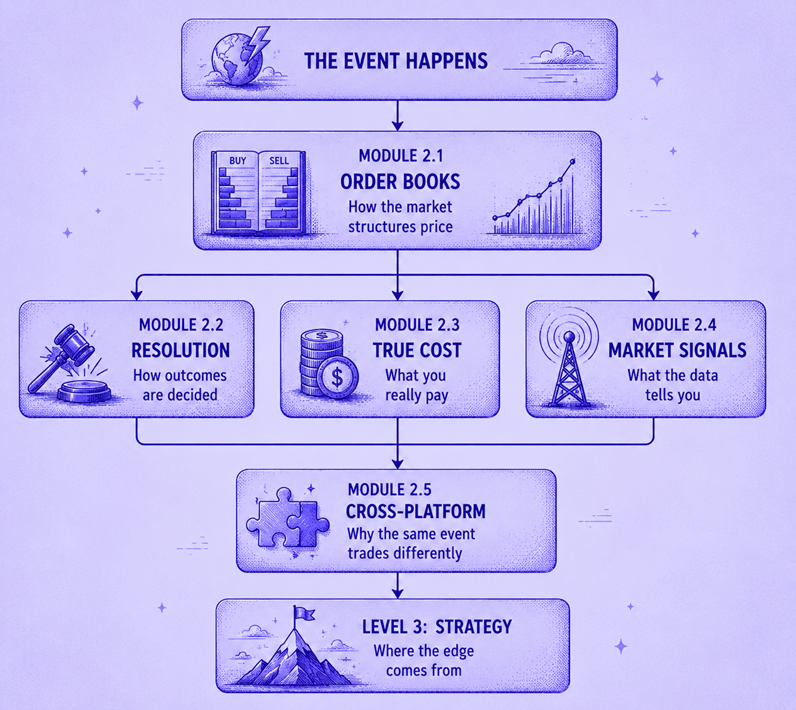
Level 1 answered: What are prediction markets and how do I use them safely?
Level 2 answered: How do prediction markets actually work under the surface?
Level 3 will answer: How do I consistently profit?
What You Learned
In this module — and Level 2 as a whole — you learned:
- Four structural reasons explain why the same event trades at different prices: fragmented participant pools, capital barriers, different resolution mechanisms, and fee-adjusted rational pricing
- Divergence is information — systematically diagnosing why prices differ reveals which crowd has better information for specific event types
- Multi-platform trading provides better price discovery, sentiment mapping, execution optimization, and risk diversification
- Level 2 is a complete mechanical framework: order books (price structure) → resolution (outcome determination) → fees (true cost) → signals (market intelligence) → cross-platform (comparative analysis)
What’s Next
Congratulations — you’ve completed Level 2: Mechanics. 🎓
You now understand how prediction markets work at a structural level — the order book mechanics, the resolution process, the true cost of every trade, how to read market signals, and how platforms interact. This knowledge puts you ahead of the vast majority of prediction market participants who never look past the price on screen.
Level 3 is where we turn knowledge into strategy. You’ll learn where the edge comes from, how to exploit systematic biases, cross-platform arbitrage, quantitative approaches, and market making. These are the modules that have the potential to make your prediction market activity genuinely profitable.
→ Level 3: Strategy — Module 3.1: Where the Edge Comes From
🎯 Try This Now: Find one active event that exists on both Kalshi (or a Kalshi-powered platform like Robinhood) and Polymarket. Compare the prices. Then diagnose the divergence using the 3-step framework: (1) Can friction explain it? (2) Do resolution criteria differ? (3) Which crowd is more likely to have better information for this specific event? Write down your diagnosis. This single exercise integrates everything you’ve learned in Level 2.
Predictionist School is a free educational resource from Predictionist.com. We may earn referral commissions from platforms we recommend — see our disclosure policy for details. This content is for educational purposes only and does not constitute financial advice.