
4.4 Trading Psychology
Key Takeaways
- Your biggest opponent is not the market — it’s your own cognitive biases, emotional reactions, and ego
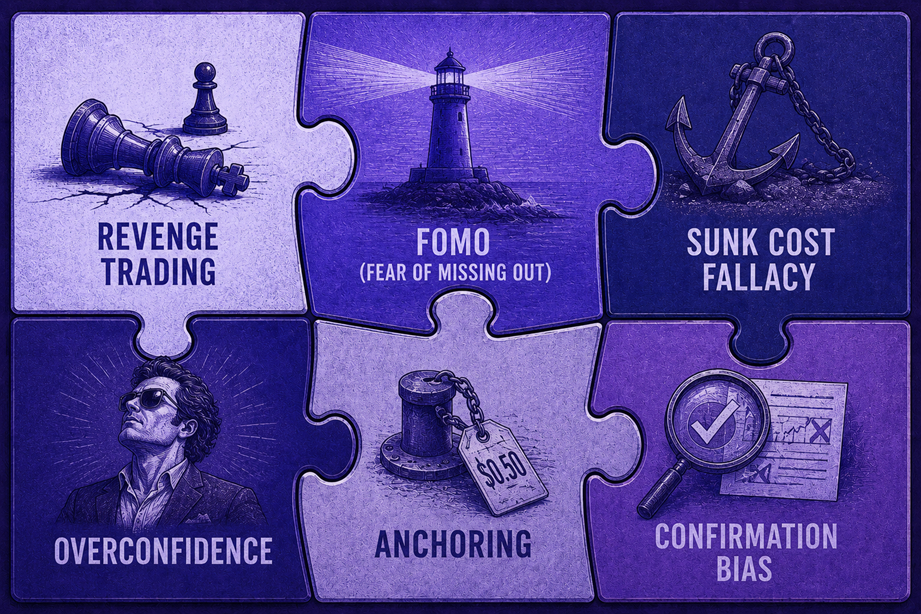
- Six psychological traps consistently destroy prediction market traders: revenge trading, FOMO, sunk cost fallacy, overconfidence, anchoring, and confirmation bias
- The antidote is not willpower — it’s systems and rules that prevent you from acting on emotion in the first place
- Emotional awareness — knowing your state before you trade — is a genuine competitive advantage, because most people never develop it
- Every bias in this module has a corresponding system-level countermeasure from earlier modules — your trading system is your psychological armor
Scope: This module addresses the cognitive and emotional challenges specific to prediction market trading. It does not cover general behavioral finance theory — it focuses on the six traps most likely to cost YOU money and the specific countermeasures from YOUR trading system. This is the psychological companion to Module 4.1: Building Your Trading System.
Trap 1: Revenge Trading
What It Is
After a loss, you feel the compulsion to immediately enter a new trade to “win it back.” The next trade is driven by emotion — the need to restore your P&L — rather than by your system’s entry criteria.
Why It’s Devastating
Revenge trades have three characteristics that make them systematically unprofitable:
- They bypass your system. You’re not waiting for proper entry signals — you’re looking for any trade
- They’re oversized. The emotional need to “make back” the loss pushes you toward larger positions than your Kelly sizing warrants
- They compound losses. If the revenge trade also loses, the emotional pressure intensifies, leading to a third trade, then a fourth — each more reckless than the last. This cascade is how accounts go to zero
The Data
The 70% retail loss rate on Polymarket is not evenly distributed across time. Losses cluster in streaks — and the trades immediately following a loss show significantly worse outcomes than trades placed during calm, systematic periods. This is the revenge trading effect: the emotional response to a loss causes the next loss, which causes the next.
Countermeasure
Your circuit breaker from Module 4.1:
- After any single trade that loses >3% of your bankroll: wait 24 hours before your next trade
- After aggregate drawdown of 15%: stop all trading for one week
- During the waiting period, review your journal. Was the loss variance or error? Act accordingly
The circuit breaker removes the option of revenge trading by making it physically impossible to place the next trade during the emotional window.
Trap 2: FOMO (Fear of Missing Out)
What It Is
You see a market moving rapidly and feel the urgent need to jump in before it’s “too late.” You haven’t analyzed the opportunity — you’ve just seen the price move and don’t want to be left behind.
Why It’s Devastating
FOMO entries happen:
- At the worst possible time (after the move has already occurred)
- At the worst possible price (you’re buying the overshoot, not the setup)
- Without proper analysis (you skipped your system’s entry criteria)
- With oversized positions (urgency overrides discipline)
Common FOMO Triggers
| Trigger | What You See | What’s Actually Happening |
|---|---|---|
| Price spike | “It went from $0.40 to $0.65 — it’s going to $0.90!” | You’re seeing the move that already happened. The edge was at $0.40, not $0.65 |
| Social media hype | “Everyone on Twitter is buying Yes on this market!” | Social consensus ≠ analytical edge. The crowd is usually wrong at extremes |
| A friend’s profit | “John made $500 on that trade — I should have been in it!” | Survivorship bias. You’re hearing about John’s winner, not his five losers |
Countermeasure
Your entry criteria from Module 4.1: Every trade must pass your selection filters and entry conditions. If you didn’t identify the opportunity before the price moved, the opportunity wasn’t yours. Accept it. Wait for the next setup that comes through YOUR system, not someone else’s timeline.
Practical rule: If you feel urgency, wait 30 minutes. If the opportunity is real, it will still be there. If it’s gone, it was based on speed you don’t have — and chasing it was the wrong move.
Trap 3: Sunk Cost Fallacy
What It Is
You hold a losing position because you’ve already “invested” money and time into it — even though the evidence now suggests your thesis is wrong.
The Inner Monologue
“I bought at $0.55 and it’s now at $0.35. But I did all this research. If I sell now, I admit I was wrong and I lose $200. Maybe it’ll come back…”
The $200 you’ve already lost is a sunk cost. It’s gone regardless of what you do next. The only question is: given the current price and current information, would you enter this position today?
If the answer is no — if you wouldn’t buy at $0.35 today — then holding it is the same as buying at $0.35. You’re making a new decision to own this position at $0.35, and your system says that’s a bad trade.
Countermeasure
Your thesis invalidation exit from Module 4.1: If new evidence shifts your estimate to within 5% of the market price, close the position — regardless of whether you’re up or down. The exit rule is based on current edge, not historical cost.
Reframing exercise: Before deciding to hold a losing position, ask yourself: “If I had zero positions and cash in my account right now, would I enter this trade at the current price with the current information?” If no, sell.
Trap 4: Overconfidence
What It Is
You believe your analysis is better than it actually is. You overestimate your edge, oversize your positions, and dismiss contradictory evidence.
How to Detect It
| Symptom | Warning Sign |
|---|---|
| “I’m sure about this one” | Certainty in probabilistic domains is a red flag. You should never be “sure” — you should be “estimated at X% with Y% confidence” |
| Increasing position sizes | If your recent wins make you feel like you’ve “figured it out” and you start sizing up, you’re in overconfidence territory |
| Dismissing the market | “The market is wrong, I’m right” without being able to articulate specifically why the crowd is systematically erring |
| Skipping sanity checks | Moving directly from analysis to execution without challenging your own reasoning |
The Dunning-Kruger Curve in Trading
Most new traders follow a predictable confidence path:
- Beginner: “This seems complicated, I should be careful” → Appropriately cautious
- Early success: “I won my first 3 trades, I’m good at this!” → Dangerously overconfident
- First major loss: “Wait, I’m not as good as I thought” → Appropriately humbled
- Sustained practice: “I know what I’m good at and what I’m not” → Calibrated confidence
Stage 2 is where the most money is lost. Early success (which may be partly or entirely luck) creates confidence that leads to larger bets and more aggressive trading — right before the reversion to mean performance.
Countermeasure
Your Brier score from Module 4.2: The objective measure of your forecasting accuracy. If your Brier score shows you’re not significantly better than the market, your “conviction” has no empirical backing. Trust the data, not the feeling.
Quarter Kelly sizing: Even if you’re convinced your edge is 25% (suggesting Full Kelly of 25%), Quarter Kelly caps you at ~6%. This built-in conservatism protects you from the consequences of overestimated edge.
Trap 5: Anchoring
What It Is
You fixate on an initial piece of information (your entry price, the first analyst opinion you read, the price when you first noticed the market) and adjust insufficiently from that anchor.
How It Manifests
- You bought at $0.60. The market drops to $0.40. You still think “it should be $0.60” because that’s where YOU entered — even though the market is telling you the information landscape has changed
- You read an analysis that says “70% probability.” You do your own research and arrive at… 68%. Suspiciously close. You anchored to the first number instead of independently deriving your own estimate
Countermeasure
From Module 3.3 (Data-Driven Trading): Always start from the base rate, not from any price or estimate you’ve previously seen. Derive your probability from fundamentals first, then compare to the market and other estimates. If you start from someone else’s number and “adjust,” you’ll always end up close to their anchor.
Practical exercise: When analyzing a market, write down your probability estimate before looking at the current market price. This removes the biggest anchor.
Trap 6: Confirmation Bias
What It Is
You seek out information that supports your existing position and dismiss or underweight information that contradicts it.
How It Manifests
- You hold a “Yes” position. You read three articles: one bullish, two bearish. You remember the bullish one clearly and barely register the bearish ones
- You check Twitter for analysis of your open position. You follow and amplify accounts that agree with you and mute or dismiss those that disagree
- Someone presents evidence against your thesis. Your first reaction is to find flaws in their evidence rather than honestly assessing whether it changes your estimate
Countermeasure
The “pre-mortem” exercise: Before entering any trade, write down: “This trade will fail because ______.” Force yourself to articulate the most plausible failure scenario. If you can’t think of one, you haven’t analyzed the trade — you’ve just convinced yourself.
Actively seek disconfirmation: After formulating your thesis, spend 5 minutes specifically looking for evidence against your position. If you find strong disconfirming evidence and your estimate doesn’t change at all, you’re probably experiencing confirmation bias.
The Emotional State Check
Before any trade, do a 10-second self-assessment:
| Question | Green Light | Red Light |
|---|---|---|
| Am I calm? | Yes | Anxious, excited, angry, desperate |
| Am I following my system? | This trade came from my process | I noticed this market 5 minutes ago and want in now |
| Am I trying to recover a loss? | No | Yes — I want to make back what I lost yesterday |
| Would I be comfortable explaining this trade to someone? | Yes — clear thesis, clear edge | No — I’d struggle to articulate why |
If any answer is a red light: do not trade. Close the platform. Go for a walk. Come back when you’re in a green-light state.
What You Learned
- Six psychological traps — revenge trading, FOMO, sunk cost, overconfidence, anchoring, and confirmation bias — are the primary cause of avoidable losses
- Systems beat willpower — every trap has a corresponding countermeasure built into your trading system from earlier modules
- The 10-second emotional check before every trade is a simple, powerful tool for preventing emotion-driven decisions
- Overconfidence is the most dangerous trap because it compounds — it leads to larger sizing, less rigorous analysis, and dismissal of contradicting evidence
- Self-awareness is a competitive advantage — in a market where 70% of participants lose money to emotional decisions, being the person who doesn’t is edge in itself
What’s Next
Psychology is the internal game. The next module addresses the intellectual framework that ties everything together: the superforecaster mindset — how the best predictors in the world think, and how to adapt their methods to prediction markets.
→ Module 4.5: The Superforecaster Mindset
🎯 Try This Now: Review your last 5 prediction market trades (real or paper). For each one, answer honestly: did any of the six traps influence your decision? Was there a trade you entered out of FOMO? One you held too long due to sunk cost? One you oversized due to overconfidence? Identifying your personal pattern is the first step to breaking it. Write it down in your journal.
Predictionist School is a free educational resource from Predictionist.com. We may earn referral commissions from platforms we recommend — see our disclosure policy for details. This content is for educational purposes only and does not constitute financial advice.