
2.2 Resolution and Settlement
Key Takeaways
- Resolution is the single most important moment in any prediction market trade — it determines whether your contracts pay $1.00 or $0.00
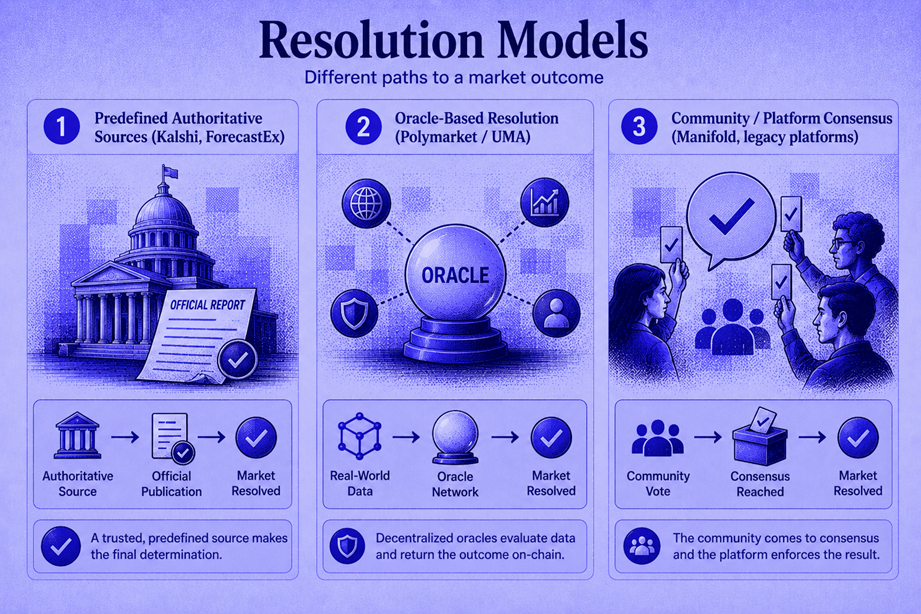
- Different platforms use fundamentally different resolution mechanisms: predefined authoritative sources (Kalshi), oracle-based voting (Polymarket/UMA), and community consensus (Manifold)
- Resolution risk — the possibility that a market resolves differently than the real-world outcome — is a distinct and underappreciated source of loss
- Your capital is locked from trade to settlement, and settlement timelines range from minutes (Kalshi) to days (disputed Polymarket markets)
- Reading resolution criteria before trading is as important as reading the price — ambiguity in the rules has cost traders millions
Scope: This module covers what happens after the event occurs — how markets determine outcomes, how funds are settled, and what happens when things go wrong. It builds on the resolution risk introduced in Module 1.4 with deeper mechanics, case studies, and practical mitigation strategies. It does not cover how to evaluate whether a market’s resolution criteria are tradeable (that’s part of your analytical framework in Level 3).
How Resolution Works: Three Models
Not all prediction markets determine outcomes the same way. Understanding the resolution model of your platform is essential because it defines the rules of the game — and those rules directly affect your risk.
Model 1: Predefined Authoritative Sources (Kalshi, ForecastEx)
This is the most straightforward model. Before a market opens, the platform specifies exactly:
- What source will be used to determine the outcome (e.g., “Bureau of Labor Statistics Employment Situation Report”)
- What reading triggers a “Yes” resolution (e.g., “unemployment rate above 4.5%”)
- What timeframe applies (e.g., “the April 2026 report, released on May 2, 2026”)
When the source publishes the data, Kalshi’s operations team compares the result against the predefined criteria and resolves the market. There is no vote, no oracle, no interpretation required.
Advantages:
- Maximum clarity — you know exactly what will determine the outcome before you trade
- Fast resolution — typically within hours of the event
- No oracle manipulation risk
Limitations:
- Kalshi sometimes encounters edge cases where the source data is ambiguous, revised, or delayed
- Limited to events that have clearly definable, authoritative data sources
- Kalshi retains discretion in unusual circumstances (e.g., if a data release is postponed)
Common resolution sources on Kalshi:
| Event Type | Resolution Source |
|---|---|
| U.S. Elections | Associated Press (AP) race calls |
| Economic indicators (GDP, CPI, unemployment) | Bureau of Labor Statistics, Bureau of Economic Analysis |
| Federal Reserve decisions | FOMC official statement |
| Weather events | NOAA / National Weather Service |
| Crypto prices | CoinGecko spot price at specified time |
| Awards | Official award ceremony announcement |
Model 2: Oracle-Based Resolution (Polymarket / UMA)
Polymarket uses the UMA Optimistic Oracle — a decentralized system where outcomes are proposed, challenged, and (if disputed) voted on by token holders.
The process:
- Proposal: After an event occurs, anyone can propose a resolution to the UMA oracle (e.g., “This market should resolve to Yes”)
- Challenge window: A two-hour window opens. If no one disputes the proposal, it’s accepted automatically
- Dispute (if challenged): If someone disagrees, they post a bond and challenge the proposal. The dispute then escalates to a vote by UMA token holders
- Token holder vote: UMA holders vote on the correct resolution. They’re incentivized to vote truthfully because voters who side with the majority earn a reward, and those who vote against the majority lose their staked tokens
- Final resolution: The outcome of the vote (or the undisputed proposal) becomes the definitive resolution
Advantages:
- Decentralized — no single entity controls the outcome
- Transparent — every proposal, dispute, and vote is on-chain and publicly auditable
- Resistant to platform censorship or unilateral override
Limitations:
- Dispute resolution can take 2–5 days, during which your capital is locked
- Token holder votes don’t always match reality. UMA voters may interpret resolution criteria differently than traders. The Zelenskyy suit market is the canonical example — token holders voted to reverse a resolution that many traders considered factually correct
- Incentive misalignment risk: If a wealthy actor accumulates enough UMA tokens, they can theoretically influence the vote. This hasn’t been demonstrated at scale, but the theoretical vulnerability exists
- Retroactive clarifications: Polymarket has occasionally issued clarifications after trading has begun, changing the effective resolution criteria mid-market. The “Trump says China” market is the most famous example
⚠️ For you as a trader, what this means: On Polymarket, you need to think about resolution criteria with the same rigor as you think about the underlying event. It’s not enough to be right about what happened — you need to be right about how UMA token holders will interpret what happened.
Model 3: Community / Platform Consensus (Manifold, legacy platforms)
Play-money platforms like Manifold Markets use community-based resolution:
- Market creators define resolution criteria
- The creator resolves the market (with community oversight)
- If the creator is unresponsive or resolves incorrectly, moderation can intervene
This model is suitable for play-money forecasting but carries obvious risks for real-money markets — the resolver has discretion, and that discretion may not align with your interpretation.
Settlement: What Happens to Your Money
Resolution tells you who won. Settlement tells you when you get paid.
Settlement on Kalshi
- Market resolves (typically same-day)
- Winning contracts are credited to your Kalshi cash balance within minutes
- Losing contracts are zeroed out
- You can withdraw funds to your bank via ACH (1–3 business days) or leave them for future trades
Capital lock period: From trade execution to resolution. Once resolved, funds are immediately available in your account.
Settlement on Polymarket
- Resolution proposal is submitted
- Two-hour dispute window opens
- If undisputed: winning USDC is released to your wallet (settled on-chain)
- If disputed: capital remains locked until the UMA vote concludes (2–5 days)
Capital lock period: From trade execution to final settlement. In the worst case (disputed resolution), your funds can be locked for up to a week.
ForecastEx (Interactive Brokers)
Settlement follows standard IBKR clearing processes. Winning positions are settled T+1 (next business day). A unique advantage: collateral earns yield while your positions are open — your locked capital is working for you, unlike on other platforms where it sits idle.
Settlement Timeline Comparison
| Platform | Normal Settlement | Disputed Settlement | Capital Earns Yield? |
|---|---|---|---|
| Kalshi | Minutes after event | Same (no oracle disputes) | No |
| Polymarket | 2–4 hours | 2–5 days (UMA vote) | No |
| ForecastEx | T+1 (next business day) | N/A | ✅ Yes |
| FanDuel Predicts | Hours | Same (via ForecastEx) | No |
| Limitless | Hours (varies) | Variable (decentralized) | No |
💡 Why settlement speed matters: If you’re an active trader managing a portfolio across multiple markets, capital that’s locked in settlement is capital you can’t deploy elsewhere. On Polymarket, a disputed resolution can lock significant funds for days. Factor this opportunity cost into your trading decisions — especially if you’re trading multiple markets simultaneously.
When Resolution Goes Wrong: Case Studies
Theory is important, but case studies teach you what theory can’t — the specific ways resolution can hurt you in practice.
Case Study 1: The Zelenskyy Suit Market
The market: “Will Zelenskyy wear a suit to [specific event]?”
What happened in real life: Zelenskyy wore what most observers would consider a suit at the event.
Initial resolution: “Yes” — proposed and initially accepted.
The dispute: A trader disputed the resolution, arguing that Zelenskyy’s attire didn’t meet the specific definition of “suit” as described in the resolution criteria.
UMA vote result: Token holders voted to reverse the resolution to “No.”
Impact: Traders who bought “Yes” — and were arguably correct about the real-world event — lost their positions. Traders who bought “No” won because they anticipated (or gambled on) the ambiguity in the resolution criteria.
Lesson: On oracle-resolved markets, the question isn’t “what happened?” — it’s “how will the oracle interpret what happened?” These are different questions, and getting the first one right doesn’t guarantee the second.
Case Study 2: The “Trump Says China” Market
The market: “Will Trump say ‘China’ during [specific address]?”
What happened in real life: Trump said the word “China” during the address.
Resolution: “No.”
Why: Polymarket issued a retroactive clarification specifying that the mention needed to be in a specific context within the address — a distinction not clearly stated in the original resolution criteria. By this narrower definition, the mention didn’t qualify.
Impact: Traders who bought “Yes” based on the plain-text reading of the market question lost money.
Lesson: Retroactive clarifications can change the effective rules after you’ve already placed your trade. On Polymarket, this risk is real. On Kalshi, resolution sources are predefined and clarifications mid-market are extremely rare (though not impossible).
Case Study 3: The Delayed Data Release
The market: “Will the April 2026 unemployment rate be above 4.5%?” (hypothetical example modeled on real events)
What happened: The BLS delayed the release of the Employment Situation Report by 48 hours due to a government IT outage.
Impact: Traders expecting to exit or collect on one market and rotate capital into another were stuck. Kalshi held the market open but suspended trading during the delay period.
Lesson: Resolution timing is never 100% certain, even when the resolution source is predefined. External factors — government shutdowns, data revision scandals, natural disasters — can delay resolution and lock your capital.
How to Protect Yourself: A Resolution Risk Checklist
Before trading any market, evaluate these six dimensions of resolution risk:
✅ 1. Read the Full Resolution Criteria
Not the headline. Not the summary. The full text. Look for:
- Specific source documents or data providers named
- Exact definitions of key terms
- Time zone and deadline specifications
- Any “at discretion of” or “in the judgment of” clauses
✅ 2. Identify the Resolution Model
Is this market resolved by:
- Predefined source → lower resolution risk
- Oracle vote → medium resolution risk (subject to interpretation)
- Market creator → higher resolution risk (play-money only)
✅ 3. Check for Ambiguity
If you can construct a plausible scenario where the event clearly happens but the market might still resolve to “No” (or vice versa), the resolution criteria are ambiguous. Trade with extreme caution or skip the market entirely.
✅ 4. Review the Dispute History
On Polymarket, check whether similar markets have been disputed before. If the same category of market (e.g., “will X person do Y thing”) has a history of disputed resolutions, that’s a red flag.
✅ 5. Factor in Settlement Timing
Ask yourself: “What’s the worst-case settlement timeline?” If a disputed resolution could lock your funds for 5 days and you need that capital for other trades, reduce your position size accordingly.
✅ 6. Prefer Objective Over Subjective Criteria
Markets resolved by numerical data (inflation at X%, Bitcoin above $Y) carry lower resolution risk than markets resolved by subjective judgment (“will X be perceived as…”). Whenever possible, trade markets with objectively verifiable outcomes.
Resolution and Your Trading Strategy
Resolution mechanics aren’t just risk factors — they’re strategic inputs. Understanding them changes how you trade.
Strategy Implication 1: Platform Selection by Resolution Type
If resolution certainty is important to your strategy, prefer Kalshi (predefined sources) over Polymarket (oracle-based) for markets that exist on both platforms. The trade-off is usually higher fees on Kalshi, but the reduction in resolution risk may be worth the premium.
Strategy Implication 2: Timing Around Resolution
Prices converge toward $0.00 or $1.00 as resolution approaches and uncertainty decreases. If you’re confident in the outcome, entering positions early (when uncertainty and potential profit are highest) and holding through resolution is optimal.
However, if you’re uncertain about the resolution mechanics (not the event), consider exiting your position before resolution — taking a profit on the price movement rather than gambling on how the oracle will interpret the result.
Strategy Implication 3: Capital Allocation Across Markets
If you’re trading multiple markets simultaneously, stagger your resolution dates. Having 80% of your capital locked in markets that all resolve in the same week leaves you with no flexibility to enter new opportunities. Diversify across time horizons just as you diversify across events.
What You Learned
In this module, you learned:
- Three resolution models exist — predefined sources (Kalshi), oracle voting (Polymarket/UMA), and community consensus (Manifold) — each with a different risk profile
- Settlement timelines vary dramatically — from minutes (Kalshi) to potentially days (disputed Polymarket markets)
- Resolution risk is real and has caused losses in well-documented cases (Zelenskyy suit, “Trump says China,” delayed data releases)
- A 6-point resolution risk checklist protects you against the most common failure modes
- Resolution mechanics are strategic inputs — they should influence your platform selection, trade timing, and capital allocation
What’s Next
You understand order books and resolution. The next module tackles the most underestimated topic in prediction market trading: the true, all-in cost of every trade — fees, spreads, slippage, gas, and how to calculate whether a trade is actually profitable after all friction is accounted for.
→ Module 2.3: Fees, Spreads, and the True Cost of Trading
🎯 Try This Now: Pick any active market on Polymarket. Click into it and find the resolution criteria (usually in the “Rules” or “About” section). Read the full text. Now ask yourself: Can I imagine a scenario where the event clearly happens in real life, but the market resolves to “No” based on the exact wording? If yes, that market carries resolution risk. Practice this exercise on 3–5 different markets to develop your resolution-reading instinct.
Predictionist School is a free educational resource from Predictionist.com. We may earn referral commissions from platforms we recommend — see our disclosure policy for details. This content is for educational purposes only and does not constitute financial advice.