

Last verified: July 28, 2026
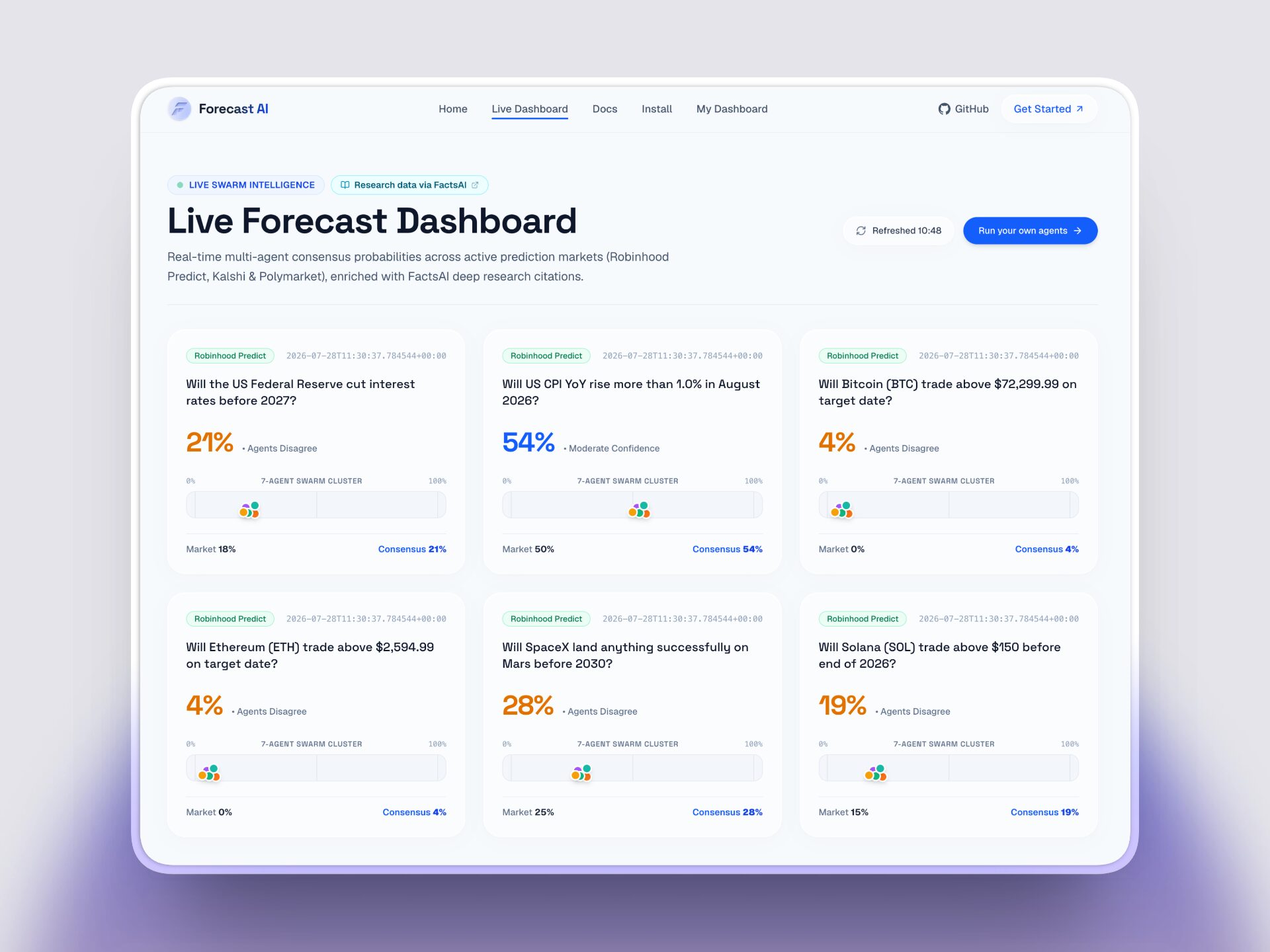
Forecast AI is an open-source multi-agent system that generates probability forecasts for Kalshi, Polymarket, and Robinhood Predict questions, then hands a structured recommendation to Robinhood’s own trading interface for you to execute yourself. One thing worth knowing before you search for it: “ForAI” and “Forecast AI” are also used by an unrelated design studio and an unrelated LLM API gateway, this review is specifically about forai.tech.
Three things you actually do with it:
- Run a question through seven agents at once. News, social sentiment, Reddit chatter, macro indicators, on-chain activity, and order book depth each get evaluated separately, then combined. This is an analytical edge: it’s not new data nobody else has, it’s the same public information processed by several models in parallel instead of one person reading headlines.
- Pick your own model, or run it locally. Forecast AI is model-agnostic: OpenAI, Anthropic, DeepSeek, or a fully local Ollama setup. That’s a structural edge over tools locked to a single vendor’s API, and it means you can run the whole thing without sending your queries to any single company if you’d rather not.
- Get a recommendation, not an execution. The consensus engine outputs a probability and a structured trade suggestion formatted for Robinhood’s Agentic Trading MCP. You paste that into your own AI client and confirm the trade yourself. Forecast AI’s infrastructure never touches your brokerage credentials or holds funds, full stop, there’s no custody question here at all because it never executes anything on its own.
Use cases
The developer who wants to test a forecasting thesis, not trade manually Research
Wants to see whether a multi-agent consensus actually beats a single model’s call on a specific Kalshi or Polymarket question, and is comfortable reading a Brier score to judge it rather than just trusting the label.
The self-hoster who doesn’t want a third party holding their API keys Self-hosted
Runs the whole stack locally with Ollama, or plugs in their own OpenAI or Anthropic key, and never routes a query through Forecast AI’s own infrastructure at all.
The builder extending the agent framework itself Automation
Writes a custom agent by extending the base ForecastAgent class to pull in a data source none of the seven default agents cover, then folds it into the same Bayesian consensus weighting as the rest.
The trader who wants a second opinion before sizing a position Analysis
Already has a view on a Robinhood Predict, Kalshi, or Polymarket question and runs it through Forecast AI as one more data point before committing size, not as an instruction to follow blindly.
Pros and Cons
- Genuinely non-custodialIt never executes trades or holds brokerage credentials at all, not because of a wallet architecture, but because execution simply isn’t something it does.
- Real, working open-source repo34 commits, an Apache 2.0 license, and a genuinely substantial codebase, not just a landing page with a “coming soon” GitHub link.
- Model-agnostic, including fully localRuns on OpenAI, Anthropic, or DeepSeek, or entirely on a local Ollama setup with no data leaving your machine.
- Free core, transparent variable costThe framework itself is free. You pay your own LLM provider directly, so the real cost scales with your own usage, not a markup.
- Extensible by designA documented base class for writing custom agents, not a closed pipeline you have to accept as-is.
- Launched within the past weekBy the team’s own account, still early stage. There’s essentially no independent track record yet, good or bad.
- Single pseudonymous developerBuilt by someone using the handle “codebyollie,” no company entity or real name attached that we found.
- “+24% Brier Score gains” is the vendor’s own claimNo published benchmark or third-party test was found to corroborate the number.
- Confusing name to search for“ForAI” and “Forecast AI” are shared by several unrelated products, so double-check you’re looking at forai.tech specifically.
- Not for a non-technical readerSetup means running a FastAPI server and, for anything beyond the defaults, writing Python. There’s no simple app for someone who just wants an answer.
Trust and credibility
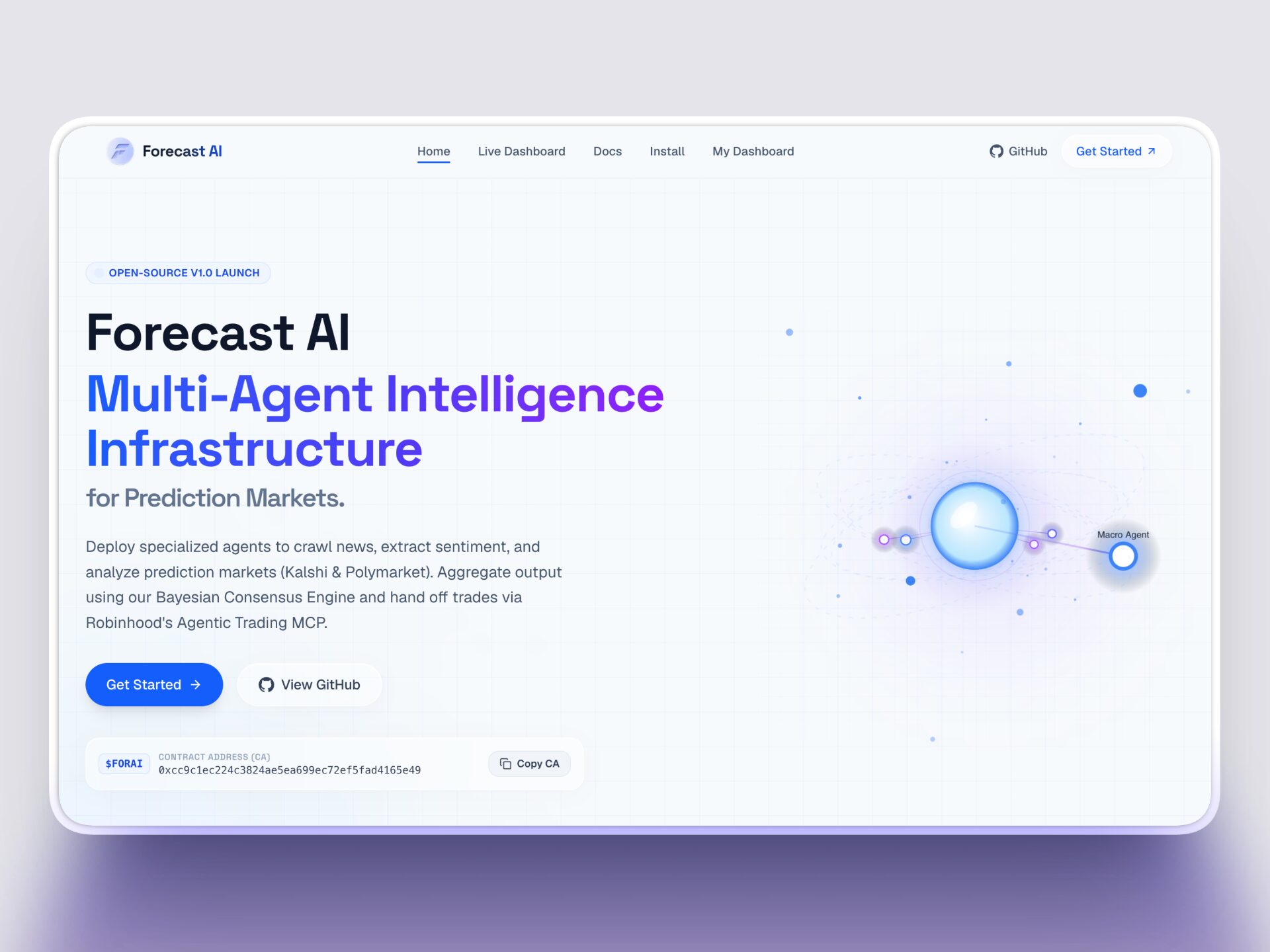
Forecast AI’s code holds up: the GitHub repo (github.com/codebyollie/forecast-agents) has 34 real commits, a genuine Apache 2.0 license, and a documentation set that covers agents, architecture, and deployment in real depth, not a placeholder repo behind a marketing site. It’s also honestly non-custodial in the strongest sense, it doesn’t execute trades at all, so there’s no wallet or brokerage credential risk to weigh here the way there is with a trading bot.
What’s thin: by the team’s own description, it’s “early stage” with a public launch just days old as of this review. The developer goes by “codebyollie” everywhere public, pseudonymous, no company entity found. A third-party directory listing shows the same handle, and separately notes its X account, @forecast_agents, has changed its username seven times since joining in October 2025, worth knowing though not necessarily damning on its own. Call this new, not emerging or established, there simply hasn’t been time for either yet.
Worth naming directly: Forecast AI’s own site claims “+24% Brier Score gains over vanilla GPT-4,” and we couldn’t find an independent benchmark backing that specific number. AI-vs-crowd forecasting claims in this exact category have a mixed real-world track record, so treat this kind of vendor-stated number as a claim, not a result, until someone outside the project has reproduced it.
If you want to see how a comparable AI-agent approach handled execution instead of just forecasting, Simmer Markets runs agents that actually place trades via API, a meaningfully different risk profile from Forecast AI’s recommend-only design. Read how order books and liquidity actually work before treating any consensus output as more than one input among several.
📍 Browse the full tools directory for every AI agent and analytics tool we’ve reviewed.
Automation level
📍 If you want to see how a comparable AI-agent approach handled execution instead of just forecasting, Simmer Markets runs agents that actually place trades via API, a meaningfully different risk profile from Forecast AI’s recommend-only design.
Frequently asked questions
An open-source multi-agent system that generates probability forecasts for Kalshi, Polymarket, and Robinhood Predict questions, then hands a structured recommendation to Robinhood’s Agentic Trading MCP for you to execute yourself. It’s not the same product as the “ForAI” design studio or LLM gateway you may find under a similar name.
Developers and technical traders comfortable running a FastAPI server or writing Python to extend it. It’s not built for someone who wants a simple app with a one-tap answer.
The framework itself is free and open source under Apache 2.0. You pay your own LLM provider (OpenAI, Anthropic, DeepSeek, or nothing at all if you run Ollama locally) directly for API usage.
No. It generates a forecast and a structured recommendation, then you paste that into your own Robinhood-connected AI client and confirm the trade yourself. It never holds brokerage credentials or executes anything on its own.
Newness more than anything. It launched three days before this review, built by a single pseudonymous developer with no independent track record yet. Its own “+24% Brier Score” accuracy claim also isn’t independently verified, treat it as a claim, not a result.
No. Simmer Markets’ agents actually place trades through an API. Forecast AI stops at a recommendation and never executes, a meaningfully different risk profile even though both are AI-agent tools covering Polymarket and Kalshi.
Yes, independently verifiable. The GitHub repo (codebyollie/forecast-agents) is real, Apache 2.0 licensed, and has 34 commits as of this review.


