How to Build a Prediction Markets Platform Checklist

A framework for evaluating platforms on your terms – from interface to funding to market access
Learn how to create a weighted evaluation checklist for prediction market platforms across six critical dimensions. This guide turns platform selection into a repeatable skill, so you can confidently choose based on your own goals rather than someone else’s rankings.
TL;DR
- Build your own checklist instead of trusting ranked lists – Other people’s ranking criteria reflect their goals, not yours. A personalized evaluation framework gives you a repeatable skill as new platforms emerge in this fast-growing market.
- Evaluate across six dimensions – Market access, user interface, funding methods, cost structure, regulatory standing, and community quality. Weight each dimension based on your personal priorities before you start comparing.
- Calculate total costs, not just headline fees – Per-contract fees, bid-ask spreads, deposit costs, withdrawal fees, and currency conversion charges all add up. Run a hypothetical round-trip trade through each platform’s fee structure to get the real number.
- Test before you commit – Create free accounts and explore interfaces before depositing money. Try a small withdrawal before making a large deposit. The friction you discover during testing saves you from bigger frustrations later.
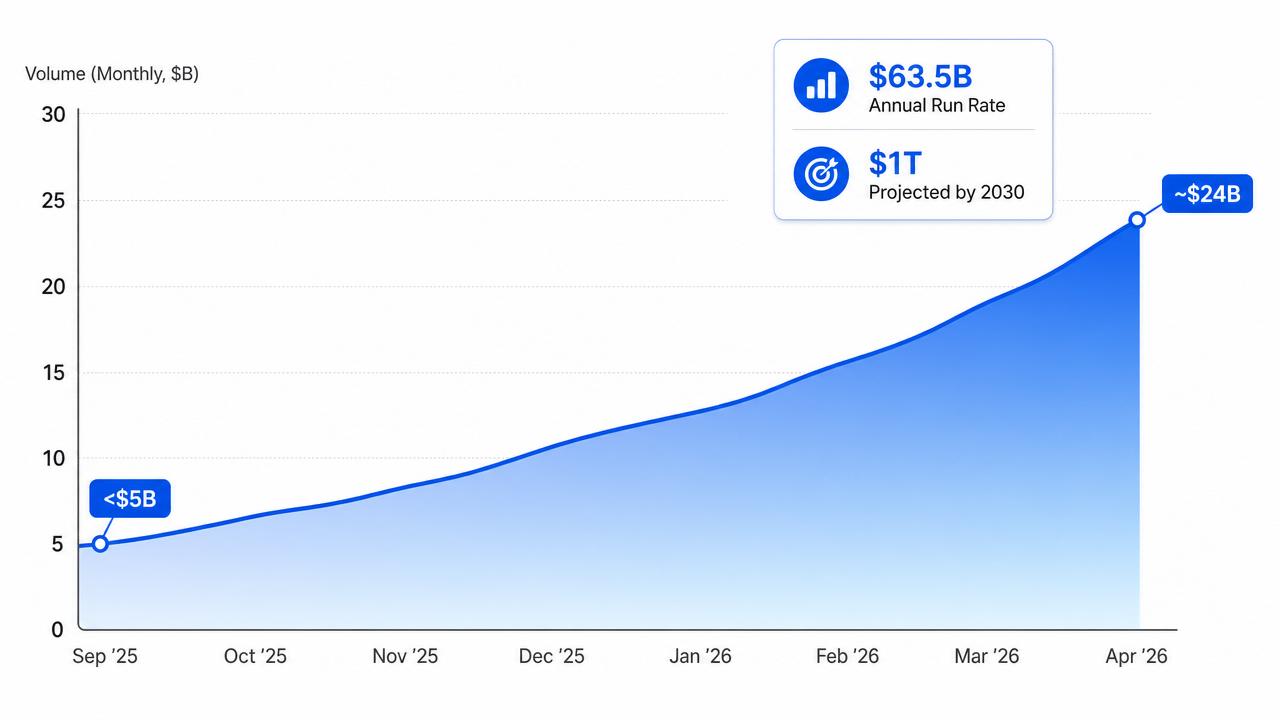
- Revisit quarterly – With prediction market volume growing from under $5 billion to $24 billion monthly in just months , platforms are changing fast. Your checklist should evolve with the market and with your own experience.
Guide Orientation: What This Covers and Who It’s For
This guide walks you through building a personalized platform comparison checklist for prediction markets. Instead of handing you a ranked list of “best platforms,” it teaches you how to create your own evaluation framework based on your goals, experience level, and trading preferences.
This is written for aspiring prediction traders, including financial analysts and data scientists who are exploring prediction markets for the first time. If you’ve felt overwhelmed by jargon-heavy reviews or frustrated by listicles that seem to rank platforms without explaining why, this is for you.
By the end, you’ll be able to evaluate any prediction market platform across six critical dimensions, build a weighted checklist that reflects your personal priorities, and confidently choose a platform without relying on someone else’s ranking criteria. We won’t recommend a specific platform or tell you where to trade. We’ll give you the skill to decide for yourself.
Why Building Your Own Prediction Markets Checklist Matters
Prediction markets are growing at a pace that makes careful platform selection more important than ever. Total volume grew roughly 400% in 2025 , reaching $63.5 billion . Bernstein analyst Gautam Chhugani projects that trading volume could reach $1 trillion annually by 2030 . With that growth comes a flood of new platforms, new market categories, and new regulatory developments, all competing for your attention and your money.
Here’s the problem: most platform comparison content is written for experienced traders or institutional investors. It assumes you already know what matters to you. It presents conclusions without showing you the reasoning behind them. If you pick a platform based on someone else’s top-five list, you might end up on a platform that’s excellent for sports contracts but terrible for economic indicator trading, or one that accepts crypto but not the funding methods you actually use.
The cost of choosing poorly isn’t just inconvenience. It can mean higher trading costs eating into thin margins, a user interface that slows your decision-making during fast-moving events, or regulatory exposure you didn’t anticipate. Building your own checklist transforms platform evaluation from a passive consumption exercise into an active, repeatable skill. That skill compounds over time as new platforms emerge and existing ones evolve.
Core Concepts: The Language of Platform Evaluation
Before building your checklist, you need to understand a few key concepts that will come up repeatedly. Let’s define them plainly.
Binary Contracts
Most prediction markets use binary contracts. These are simple yes-or-no propositions: “Will the Federal Reserve cut rates before September?” You buy a contract at a price between $0 and $1 (or 0 and 100 cents). If the event happens, the contract pays out $1. If it doesn’t, it pays $0. The price reflects the crowd’s estimated probability of the event occurring. Our School covers this mechanic in more depth if you want the full walkthrough.
Regulated vs. Unregulated Platforms
Some platforms operate under CFTC regulations (the Commodity Futures Trading Commission, which oversees derivatives markets in the US) – Kalshi is the clearest example. Others, like Polymarket , operate offshore or on blockchain infrastructure outside traditional regulatory frameworks. This distinction affects everything from the types of markets available to your legal protections and tax compliance obligations. Neither category is inherently “better,” but the tradeoffs are real and personal.
Liquidity
Liquidity refers to how easily you can buy or sell contracts without significantly moving the price. A market with high liquidity has many active participants, tight bid-ask spreads, and fast execution. Low-liquidity markets can trap you in positions or force you to accept unfavorable prices. Some research suggests accuracy climbs into the 90s as liquidity increases , though the exact figure varies study to study – which tells you something about why this metric matters beyond just convenience.
Event-Driven Markets vs. Continuous Markets
Some contracts resolve on a specific date (“Who will win the 2026 World Cup final?”), while others track ongoing conditions (“Will inflation exceed 3% this quarter?”). The type of market you’re most interested in should shape which platforms you prioritize, because not every platform covers every category equally.
The Framework: Six Dimensions of Platform Evaluation
Your checklist will evaluate platforms across six interconnected dimensions. Think of these as lenses, not rankings. Each dimension matters differently depending on your goals.
- Market Access – What can you actually trade?
- User Interface – Can you execute decisions efficiently?
- Funding Methods – How do you get money in and out?
- Cost Structure – What are you paying, visibly and invisibly?
- Regulatory Standing – What protections and restrictions apply?
- Community and Information Quality – What signals can you access beyond the contract price?

These dimensions are not independent. A platform with excellent market access but poor liquidity in most categories effectively limits your real access. A platform with low fees but expensive funding methods might cost you more overall. Your checklist should capture these interactions, not just score each dimension in isolation.
Step-by-Step: Building Your Checklist
Step 1: Define Your Market Access Requirements
Objective: Identify which market categories matter to you and verify that candidate platforms actually offer them with sufficient depth.
Start by listing the types of events you want to trade. Are you drawn to political outcomes, economic indicators, sports, technology milestones, or cultural events? Your answer narrows the field immediately. Economic prediction markets surged 905% in 2025 , reaching $112 million in volume , while tech and science markets rose 1,100% to $123 million . These numbers suggest rapid expansion in categories that were barely available a year or two earlier.
For each platform you’re evaluating, check: How many active markets exist in your category of interest? Are new markets being added regularly? Can users propose new markets, or does the platform control all listings? A platform might advertise “thousands of markets” but have only a handful in the economic indicator trading category you care about.
What to avoid: Don’t assume that the platform with the most total markets is the best fit. Volume concentration matters. Kalshi controls approximately 89% of regulated prediction market activity in the US (worth confirming against a second source, since this figure moves fast), but that dominance is spread unevenly across market types. Check depth in your specific areas of interest, not just headline numbers.
How to verify: Browse each platform’s active market listings yourself. Count the markets in your target categories. Check whether the most recent markets in your category have meaningful trading volume or sit dormant with wide bid-ask spreads.
Step 2: Evaluate the User Interface for Your Decision Style
Objective: Determine whether the platform’s interface supports the way you actually think and trade, rather than just looking polished.
The user interface of a prediction market platform is more than aesthetics. It’s the layer between your analysis and your execution. A confusing interface slows you down during time-sensitive events. An overly simplified one might hide critical information like order book depth or historical probability charts.
When evaluating a user interface, ask yourself these questions: Can you find the information you need within 10 seconds of opening a market? Does the platform show probability history over time, or only the current price? Can you place limit orders (setting your own price) or only market orders (accepting the current price)? Is the mobile experience functional for monitoring positions, or is it desktop-only in practice?
What to avoid: Don’t conflate “clean design” with “good interface.” Some of the most visually appealing platforms strip out features that experienced traders need. Conversely, don’t dismiss a platform with a dense interface if it gives you the data you want. Match the interface to your decision style, not to a design award.
How to verify: Create a free account on each platform and spend 15 minutes exploring before depositing any funds. Try to find a specific market, read its resolution criteria, check the order book, and simulate placing a trade. If any of those steps frustrate you, note it on your checklist.
Step 3: Map Your Funding Methods and Withdrawal Paths
Objective: Confirm that you can move money in and out of the platform efficiently, affordably, and through methods you’re comfortable using.
Funding methods vary dramatically across platforms. Regulated US platforms like Kalshi typically accept bank transfers (ACH), debit cards, and sometimes wire transfers. Blockchain-based platforms like Polymarket require cryptocurrency (usually USDC on the Polygon network), which adds a conversion step if you’re starting with traditional currency. Some platforms accept alternative payment methods like Apple Pay or specific e-wallets.
Your checklist should capture: Which deposit methods does the platform accept? What are the deposit fees and minimums? How long do deposits take to clear? What are the withdrawal methods, fees, and processing times? Are there withdrawal limits that could affect you?
What to avoid: Don’t overlook withdrawal friction. Getting money into a platform is usually easy because platforms are incentivized to make deposits seamless. Getting money out is where you discover the real costs. Some platforms impose waiting periods, minimum withdrawal amounts, or fees that aren’t obvious during signup.
How to verify: Read the platform’s fee schedule page (not just the marketing page). Search for user reviews specifically mentioning withdrawal experiences. If a platform requires crypto deposits, factor in the gas fees and exchange conversion costs as part of your total funding cost.
Step 4: Calculate the True Cost of Trading
Objective: Understand all the costs you’ll pay, not just the advertised commission rate.
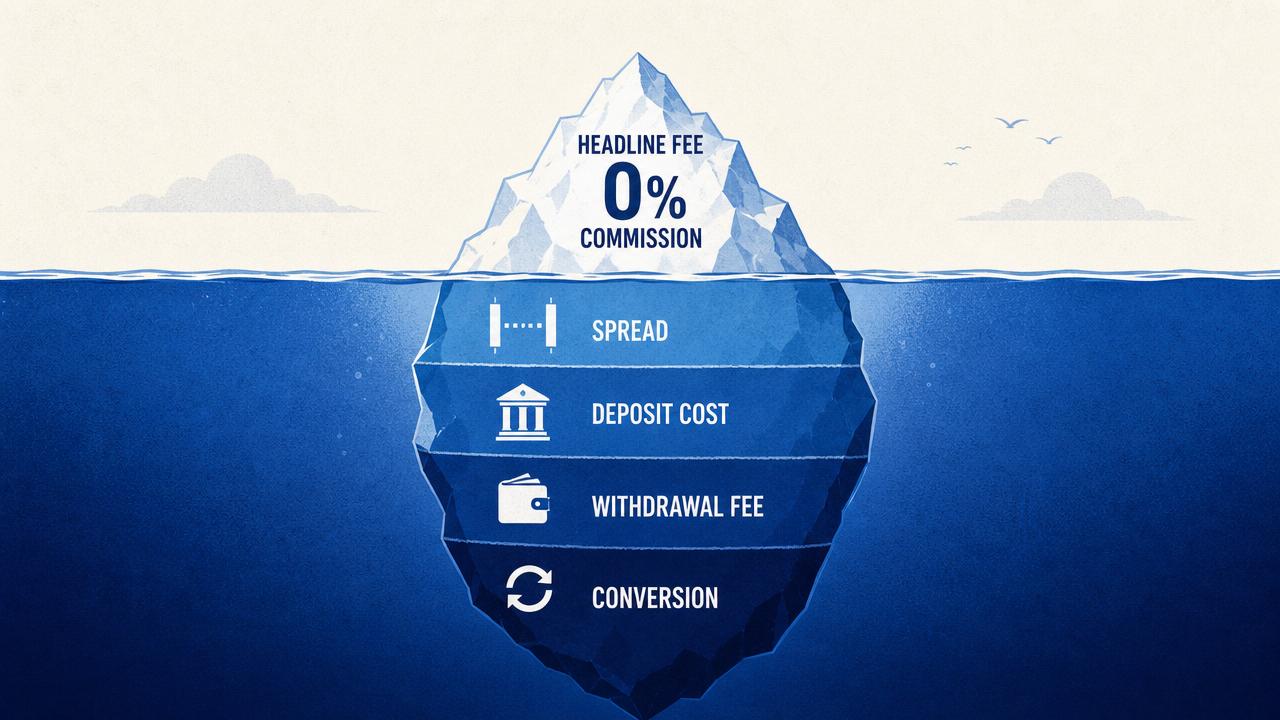
Trading costs on prediction market platforms typically include some combination of: per-contract fees (often a few cents per contract) , spread costs (the gap between the buy and sell price), withdrawal fees, and sometimes inactivity fees. The headline fee might be “no commission” while the spread quietly takes 5-10% of your position value in low-liquidity markets .
Build a cost model for a typical trade you’d make. If you plan to buy 100 contracts at $0.60 and sell them at $0.75, calculate: What’s the per-contract fee on entry and exit? What’s the typical spread in markets you’d trade? Are there any fees on winning payouts? What’s the total cost as a percentage of your expected profit? This exercise often reveals that platforms with “zero fees” cost more than platforms with transparent per-contract charges.
What to avoid: Don’t compare platforms on fee structure alone without considering liquidity. A platform with slightly higher fees but much tighter spreads (because of deeper liquidity) will often cost you less per trade in practice. Also avoid ignoring the tax compliance dimension. Regulated platforms typically issue 1099 forms, while unregulated ones may leave tax reporting entirely to you, which creates hidden administrative costs.
How to verify: Run the same hypothetical trade through each platform’s fee calculator (if available) or manually calculate using their published fee schedules. Compare the all-in cost, including deposit, trading, and withdrawal fees, for a round-trip trade of the same size.
Step 5: Assess Regulatory Standing and Your Risk Tolerance
Objective: Understand the regulatory environment each platform operates in and decide what level of regulatory protection matches your comfort level.
This is where platform evaluation gets personal. A CFTC-regulated platform like Kalshi offers legal protections, segregated customer funds, and clear dispute resolution. It also comes with restrictions: certain market types may be prohibited by regulatory actions, and geographic availability is limited. A blockchain-based platform like Polymarket may offer broader market categories and global access, but with fewer consumer protections and more ambiguity around legal status.
Your checklist should capture: Is the platform registered with a recognized regulator (CFTC, state regulators, or international equivalents)? Does the platform segregate customer funds from operating funds? What happens to your money if the platform shuts down? Are there pending regulatory actions or legal challenges that could affect the platform’s operations? Our coverage of recent CFTC developments shows that this landscape is actively shifting.
What to avoid: Don’t assume regulated automatically means “safe” or unregulated means “risky.” Regulation protects against certain types of risk (fraud, fund mismanagement) but doesn’t protect you from trading losses or guarantee market quality. Similarly, unregulated platforms can be well-run and transparent. Evaluate the specific protections, not just the label.
How to verify: Check the CFTC’s list of designated contract markets for US-regulated platforms. For non-US platforms, look for registration with equivalent bodies. Read the platform’s terms of service, specifically the sections on fund custody and dispute resolution.
Step 6: Evaluate Community, Information Quality, and Educational Resources
Objective: Determine whether the platform’s ecosystem helps you make better decisions or just provides a place to execute trades.
Some platforms offer rich community features: comment sections on individual markets, trader profiles showing track records, and integrated news feeds. Others are purely transactional. For an aspiring trader, the information environment surrounding a platform can be as valuable as the platform itself.
Consider: Does the platform provide resolution criteria that are clear and unambiguous? Is there a community discussion feature where you can see other traders’ reasoning? Does the platform publish educational content or market analysis? Are there external communities (Discord servers, Twitter accounts, newsletters) that discuss this platform’s markets? We built our School to supplement exactly this gap – helping you evaluate markets and understand contract mechanics regardless of which platform you choose.
What to avoid: Don’t mistake activity for quality. A busy comment section full of memes and hype is less valuable than a quiet one with well-reasoned analysis. Also avoid platforms where resolution criteria are vague or subject to frequent changes, as this introduces a form of risk that no amount of good analysis can overcome.
How to verify: Read the resolution criteria for five markets on each platform. Are they specific, measurable, and tied to a named source. Check whether past markets resolved cleanly or generated disputes. Look at community discussions (if they exist) and assess whether they contain substantive analysis.
Putting It Together: A Practical Example
Let’s say you’re a data scientist interested in economic indicator trading. You want to trade markets related to inflation data, employment reports, and Federal Reserve decisions. Here’s how your checklist might look in practice, using two real platforms as a reference point (treat the specific numbers below as illustrative – confirm current fees and market counts yourself before deciding).
Scenario: Comparing Two Real Platforms
Kalshi is CFTC-regulated, accepts bank transfers, charges roughly a cent per contract , offers dozens of active economic markets, has a clean but basic interface, and provides no community features. Polymarket is blockchain-based, requires USDC deposits, charges no per-contract fee but has wider spreads, offers a smaller but fast-growing set of economic markets, has advanced charting tools, and hosts active community discussions.
Best for Traders who want legal protection and simple bank funding
- Regulated and segregated fundsCFTC oversight, clear dispute resolution, your money kept separate from the platform’s.
- Familiar fundingBank transfer (ACH), debit card, and wire. No crypto step to learn first.
- Transparent per-contract costRoughly a cent per contract, so the price you see is close to the price you pay.
- Strong economic and political depthDeep liquidity in Fed, inflation, and election markets – the core data-driven categories.
Basic interface, no community layer, and limited geographic access.
Read the full Kalshi reviewBest for Traders who want the widest market choice and richer tools
- Broadest market catalogThe widest range of categories, with new markets added fast as events break.
- Advanced chartingProbability history and deeper price tools for traders who read the movement, not just the snapshot.
- Active communityMarket-level discussion where you can see other traders’ reasoning, not just the price.
- No per-contract feeZero headline commission, though the spread on thinner markets is where the real cost sits.
USDC deposits add a conversion step, and consumer protections are thinner.
Read the full Polymarket reviewTwo platforms, two profiles – neither wins outright. Score them against your own six-dimension weights before you decide. Figures here are illustrative, not live pricing.
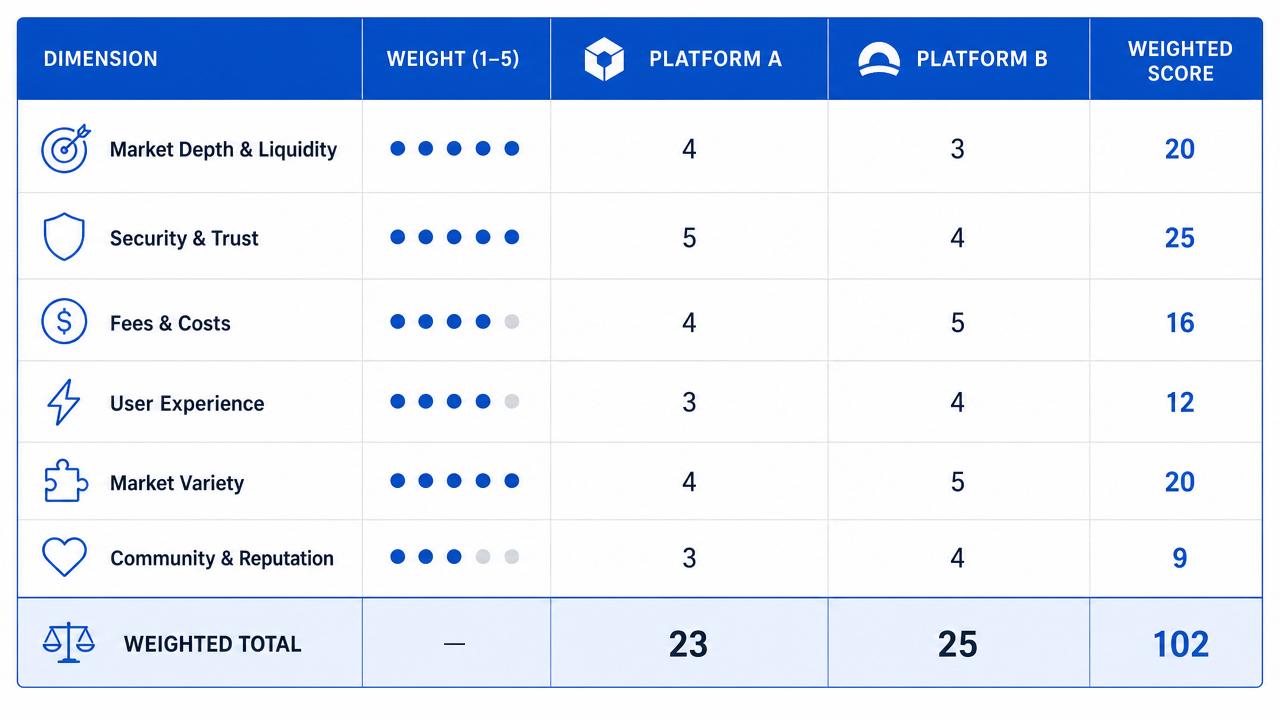
Using your weighted checklist, you might score them like this: If regulatory protection and easy funding are your top priorities, Kalshi scores higher despite fewer features. If you value advanced charting, community insight, and emerging market categories, Polymarket might win despite the crypto deposit requirement. Neither platform is objectively “better.” Your checklist makes the tradeoffs visible and personal. See our full Kalshi review and Polymarket review for the complete breakdown.
Weighting Your Dimensions
Not every dimension deserves equal weight. Assign each of your six dimensions a weight from 1 (nice to have) to 5 (deal-breaker). A trader focused on high-volume sports events like the World Cup might weight market access and liquidity at 5 but regulatory standing at 2. A cautious newcomer might weight funding methods and regulatory standing at 5 but community features at 1. Write your weights down before you start evaluating. This prevents you from unconsciously adjusting your criteria to justify a platform you’ve already decided on.
Common Mistakes and Pitfalls
Anchoring on a single feature. A platform with the lowest fees isn’t automatically the best choice if its markets are illiquid. Evaluate holistically across all six dimensions.
Skipping the test drive. Many traders pick a platform based on reviews and deposit money without ever exploring the interface. Spend time on the platform before committing funds.
Ignoring withdrawal mechanics. Getting money out is the most overlooked part of platform evaluation. Test a small withdrawal before making a large deposit.
Treating your checklist as permanent. The prediction market landscape is changing fast. Monthly global trading volume rose from less than $5 billion in September 2025 to about $24 billion by April 2026 . Platforms that are strong today may fall behind tomorrow. Revisit your checklist quarterly.
Copying someone else’s rankings. The entire point of this exercise is to build evaluation criteria that reflect your goals. A top-rated platform for a political junkie might be useless for someone focused on economic data. Trust your own framework.
What to Do Next
Start with one step: write down the three market categories you’re most interested in trading. That single decision will immediately narrow your platform options and give your checklist a concrete foundation to build on.
Then, create a simple spreadsheet with six columns (one for each dimension) and rows for each platform you’re considering. Fill it in over a week, spending a few minutes each day exploring one platform. Don’t rush to a final decision. The goal isn’t to find the “perfect” platform. It’s to find the best platform for you right now, with the understanding that you can revisit and adjust as your experience grows and the market evolves.
If you want to deepen your understanding of how prediction markets work before you start evaluating platforms, our School breaks down core concepts without assuming prior knowledge. Use this guide as a reference document you return to whenever a new platform catches your attention or an existing one changes its terms.
Frequently Asked Questions
Prediction markets are platforms where you buy and sell contracts based on the outcome of future events. Each contract is typically priced between $0 and $1, with the price reflecting the crowd’s estimated probability of the event happening. If you buy a “yes” contract at $0.40 and the event occurs, you receive $1.00, netting $0.60 in profit. If it doesn’t occur, you lose your $0.40. This structure turns collective opinion into probabilistic price signals that often prove remarkably accurate.
The CFTC (Commodity Futures Trading Commission) regulates derivatives markets in the US, including certain prediction market platforms like Kalshi . CFTC oversight means the platform must segregate customer funds, follow specific operational standards, and provide dispute resolution mechanisms. This matters because it protects you against fraud and fund mismanagement. However, CFTC-regulated platforms may also have restrictions on which market categories they can offer, so regulation involves tradeoffs between protection and market access.
Trading costs vary significantly. Some platforms charge per-contract fees (often $0.01 to $0.05 per contract). Others advertise “zero fees” but build costs into wider bid-ask spreads. You also need to account for deposit fees, withdrawal fees, and currency conversion costs (especially on crypto-based platforms like Polymarket ). The most accurate comparison calculates the total round-trip cost of a typical trade, including all fees from deposit through withdrawal, not just the headline commission rate.
Regulated US platforms typically accept bank transfers (ACH), debit cards, and wire transfers. Blockchain-based platforms usually require cryptocurrency deposits, most commonly USDC stablecoins. Some platforms also accept Apple Pay, Google Pay, or specific e-wallets. The key is to check not just deposit methods but also withdrawal options, as these sometimes differ and can involve higher fees or longer processing times.
Focus on functionality over aesthetics. Key questions include: Can you quickly find and understand specific markets? Does the platform display probability history charts? Can you place limit orders (not just market orders)? Is the mobile experience usable for monitoring positions? Does the interface show order book depth so you can gauge liquidity? The best test is spending 15 minutes exploring the platform before depositing any money, simulating the process of finding a market, reading its resolution criteria, and placing a trade.
Review your checklist at least quarterly. The prediction market industry is evolving rapidly, with new platforms launching, existing ones adding market categories, and regulatory frameworks shifting. A platform that scored poorly six months ago might have improved significantly, and one that scored well might have changed its fee structure or faced regulatory challenges. Your own priorities may also shift as you gain experience and discover which market categories interest you most.