Kalshi vs Polymarket: 2026 Comparison

Last verified: July 24, 2026
TL;DR — Who should use which?
| Kalshi | Polymarket | |
|---|---|---|
| Best for | Beginners and US sports traders | Intermediate traders comfortable with crypto wallets |
| Regulation | CFTC-regulated DCM since November 2020 | CFTC-regulated DCM on its US entity since late 2025 |
| US users | Yes, all 50 states at the federal level | Partial. US app available, offshore site blocks US IPs |
| Main market types | Sports, politics, economics | Politics, sports, crypto, culture, world events |
| Fee model | Formula-based taker fee, peaks near 3.5% of stake at 50¢, near-zero at the extremes | Tiered taker fee by category, 4-7%, only geopolitics is fee-free |
| Beginner friendly | Yes. Dollar funding, no wallet needed | Partial. Offshore site expects USDC and Polygon basics |
| API access | Yes, public REST and WebSocket | Yes, public CLOB API with Python and TypeScript SDKs |
| Our pick for | Someone funding with a debit card who wants sports contracts | Someone already holding crypto who wants the deepest liquidity |
If you’re in the US and don’t want to touch a crypto wallet, Kalshi is the simpler on-ramp. If you want the largest, deepest market on the planet and don’t mind USDC, Polymarket still wins on raw liquidity. Read on for where that split actually matters, and where it doesn’t.
Overview: Kalshi and Polymarket
Both platforms had a real 2025. Kalshi launched in 2018, co-founded by two MIT graduates, and became the first CFTC-regulated Designated Contract Market for event contracts in November 2020. That head start is why every regulatory comparison below starts with Kalshi. By 2025 it had raised a $1B Series F at a $22B valuation, with backers including Sequoia, a16z, Paradigm, and Morgan Stanley. Its 2025 notional volume hit $23.8B, and sports contracts (NFL, NBA, college football) now make up 75-90% of that volume, which tells you where the growth actually came from even if “event contracts” was the original pitch.
Polymarket is the larger of the two by cumulative volume: roughly $19B traded since it launched in 2020. It runs on Polygon, settles in USDC, and resolves markets through UMA’s optimistic oracle rather than a human desk, a genuinely different resolution model we get into below. What changed most for Polymarket wasn’t volume. It was legitimacy: Intercontinental Exchange, the company that owns the NYSE, committed up to $2B at an $8B valuation in late 2025 and now distributes Polymarket’s data feed to institutional clients. Pair that with Polymarket’s own CFTC Designated Contract Market status landing the same year, and a platform that spent five years as an offshore crypto product now has one foot inside US regulatory infrastructure.
Regulation and legal status
This is the split that decides which platform you can even use.
Kalshi’s regulatory status
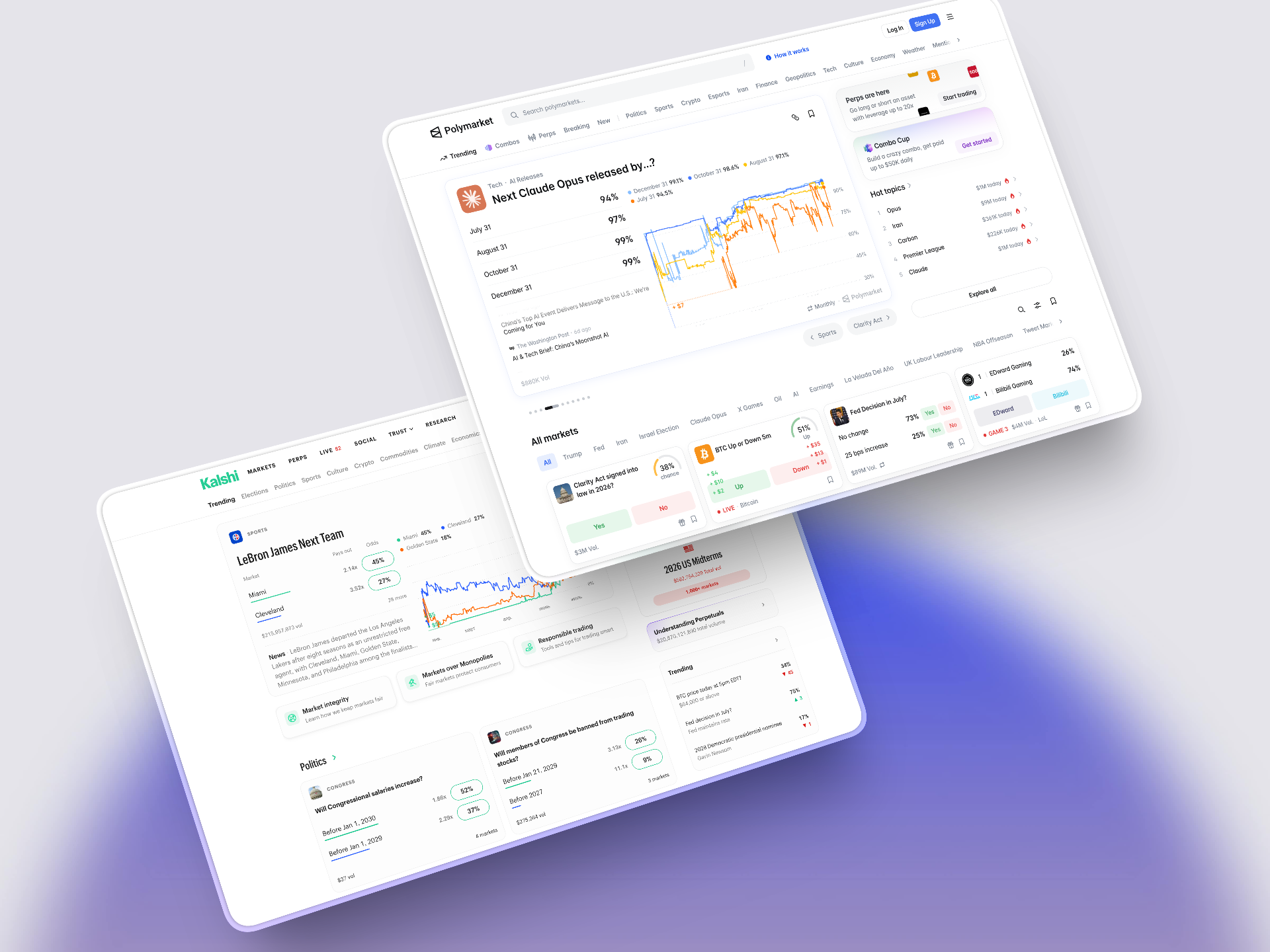
Kalshi has operated as a CFTC-approved Designated Contract Market since November 2020, the longest track record of any US prediction market. That said, several states, including Nevada, New Jersey, and Massachusetts, have issued cease-and-desist orders over its sports contracts specifically. Federal approval doesn’t automatically override every state gambling regulator, and that fight is still active. If you’re in one of those states, check current status before funding an account, not after.
Polymarket’s regulatory status
Polymarket’s regulatory story is newer and split in two. Its original offshore platform blocks US IP addresses entirely, and using a VPN to get around that violates its terms of service, with account bans documented during high-volume periods. Its separate US entity received CFTC Designated Contract Market status in late 2025, giving eligible US residents a regulated on-ramp that didn’t exist a year earlier. You can check either platform’s current standing directly on the CFTC’s site.
Is either platform actually legit?
Polymarket’s own search results are full of “is Polymarket legit or a scam?” headlines, and Trustpilot carries several hundred reviews with a polarized spread. Some of that is just crypto-platform skepticism, some of it is genuine dispute-resolution friction that predates the CFTC-regulated US entity.
Neither platform is a toy, though. Both settle real contracts with real payouts, but you’re trading with money that can go to zero on a bad call, on either platform, regulated or not. Treat that as a fact about the category, not a knock on either company specifically.
Markets and trading
Kalshi runs contracts on sports, politics, weather, and economic data like Fed rate decisions and CPI prints, priced as yes/no event contracts. Sports has grown to dominate the book, which is good if that’s what you’re after and less good if you wanted a deep political-markets venue.
Polymarket spreads wider: politics, sports, crypto, culture, and general world events, all as binary yes/no contracts priced between $0 and $1. Its order book model is a genuine central limit order book, the same maker/taker structure a traditional exchange uses, where most competitors run automated market makers instead. That’s a real structural difference in how prices form, not just a marketing line.
How each platform actually settles a trade
This is the part most comparisons skip, and it matters more than it sounds. Kalshi resolves contracts through its own market operations desk, similar to how a traditional exchange settles a futures contract, drawing on the source data specified in each contract’s rules (a government report, a league’s official result, and so on). Polymarket resolves through UMA’s optimistic oracle: anyone can propose an outcome, and if nobody disputes it within a set window, it finalizes. If someone does dispute it, UMA token holders vote. It’s decentralized by design, which is the point for a platform that doesn’t want a single company deciding outcomes, but it also means resolution can take longer on contested or ambiguous markets, something worth knowing before you put size into an edge-case contract.
KYC and verification
Kalshi requires standard identity verification up front, full stop. Polymarket’s US entity requires it too, but the offshore site historically let you trade without it, one more reason the offshore product stays closed to US residents specifically.
Liquidity and market depth
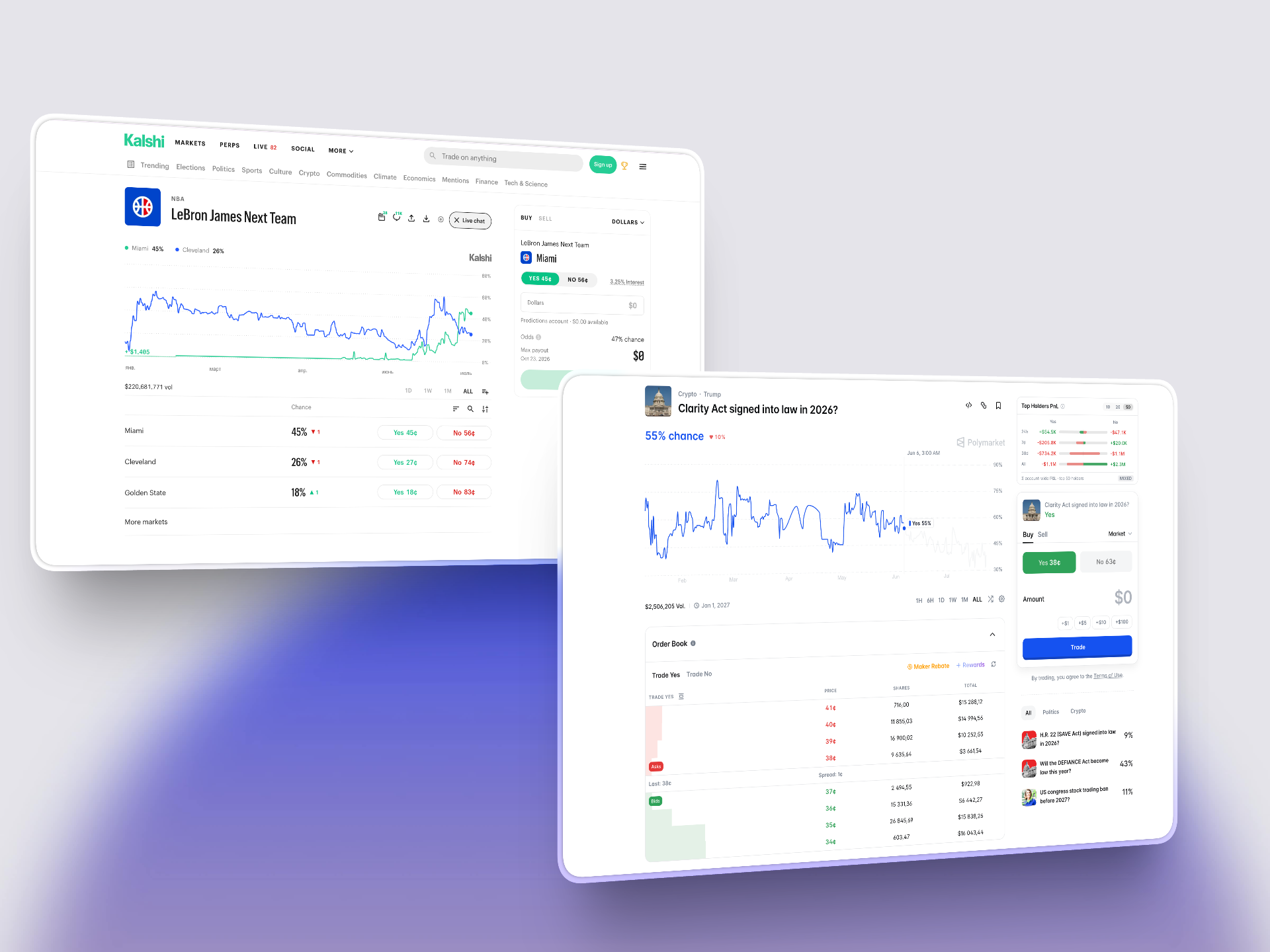
Depth is where the two platforms diverge the most for anyone trading real size, and it’s the part beginner-focused comparisons usually skip entirely.
Kalshi’s liquidity concentrates hard in sports, especially mainstream US leagues during their season. That’s a direct result of its 75-90% sports mix. A Thursday-night NFL contract can have real, tight two-sided markets. A niche economic-data contract three weeks out often doesn’t, and you’ll feel that in the spread the moment you try to size into it.
Polymarket’s CLOB structure means liquidity is visible before you trade, not just implied by a quoted price, which matters if you’re used to reading an order book rather than trusting a single number. Its political and major-event markets are generally the deepest anywhere in the category, a direct result of being the largest platform by cumulative volume and the one institutional players like ICE now watch closely. Smaller or newer Polymarket markets can still be thin, the CLOB model doesn’t create liquidity out of nothing, it just makes the thinness visible instead of hidden.
The practical takeaway: if you’re trading small, contract-pricing versus order-book mechanics barely matters, slippage on either platform is a rounding error. If you’re moving real size, check the actual book (Polymarket) or recent volume on that specific contract (Kalshi) before you commit, not the platform’s overall reputation for liquidity. “Deep platform” and “deep market for this specific contract” are not the same claim, and treating them as the same one is how size traders get bad fills. If you want the mechanics behind any of this, our primer on order books and liquidity covers it from scratch.
Fees
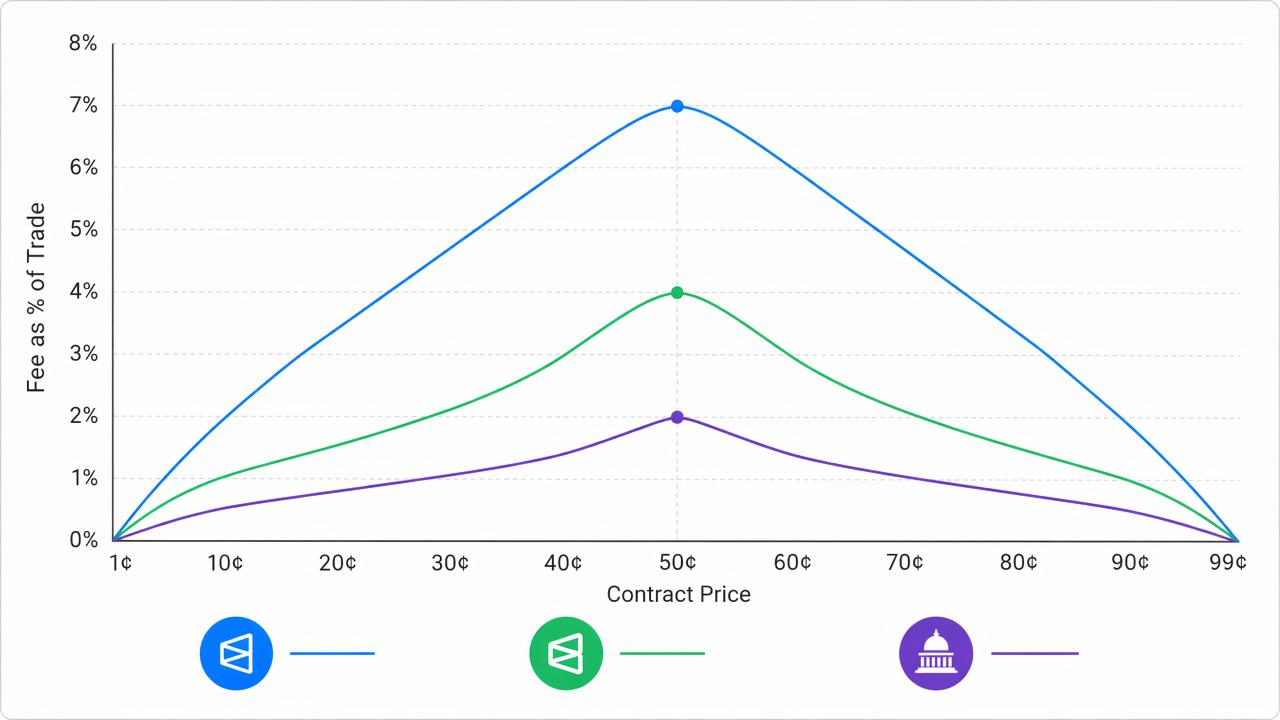
Both platforms charge trading fees the same unusual way: as a curve that peaks when a contract is priced near 50¢ (a genuine coin-flip) and shrinks toward almost nothing as the price approaches 1¢ or 99¢ (a near-certain outcome). That’s because the fee is a percentage of the risk being priced, not a flat cut of your stake, so a longshot or a near-lock costs you almost nothing to trade either way.
How Kalshi calculates fees
Kalshi charges one flat rate everywhere, no matter the category: 7% of the risk being priced, worked out per contract and rounded up to the next cent. In practice that tops out around 3.5% of your actual stake on a coin-flip (50¢) contract, and drops close to zero on a near-certain one. Resting orders that later fill (maker orders) get a quarter of that rate instead of the full amount. There’s no separate settlement fee on top.
How Polymarket calculates fees
Polymarket doesn’t use one flat rate, it varies by category, and every tier is steeper than Kalshi’s: 4% on politics, finance, tech, and mentions markets; 5% on sports, economics, culture, and weather; 7% on crypto, the most expensive category on the platform. Geopolitics markets are the one exception, with no taker fee at all. Makers pay $0 everywhere and instead split a daily rebate pool, roughly 15-25% of that day’s collected fees depending on category.
| Kalshi | Polymarket | |
|---|---|---|
| Highest fee (50¢ contract) | About 3.5% of your stake, same rate everywhere | 4% to 7% of your stake, depending on category |
| Lowest fee (near-certain contract) | Drops close to 0% | Drops close to 0%, same shape as Kalshi |
| Fee-free category | None | Geopolitics |
| Resting (maker) orders | Quarter of the normal rate | $0, plus a share of daily rebates |
| Debit card deposit | 2% | Not offered |
| Bank transfer (ACH/wire) | Free | Not offered |
| Crypto deposit or withdrawal | Not offered | Free, only network gas (roughly $3-10) |
A worked example
Take a $500 position at a 50¢ price, the worst case on both platforms since that’s exactly where the fee curve peaks. On Kalshi that’s 1,000 contracts, working out to $17.50 in fees. On Polymarket, in the sports category (5%), that same $500 buys 1,000 shares for a fee of $12.50. Move that same $500 into a 90¢ near-lock instead and Kalshi’s fee drops to about $3.50, the formula shrinks fast once you’re off the coin-flip price. That’s the pattern worth remembering more than any single number: a price near 50¢ costs the most on either platform, and both are built so a confident, lopsided bet barely costs anything to place.
Check Kalshi’s fee schedule directly before you trade, and cross-reference Polymarket’s category fees against a current breakdown like this one. Categories and rates have moved at least twice in 2026 already, most recently when Polymarket raised its sports taker fee from 3% to 5% in July.
User experience
Kalshi is built for someone who has never touched crypto. Standard KYC, funding via debit card, ACH, or wire, and a mobile app that doesn’t ask you to understand a wallet. It’s also distributed inside Robinhood and Webull now, which lowers the friction even further for anyone who already has one of those apps installed.
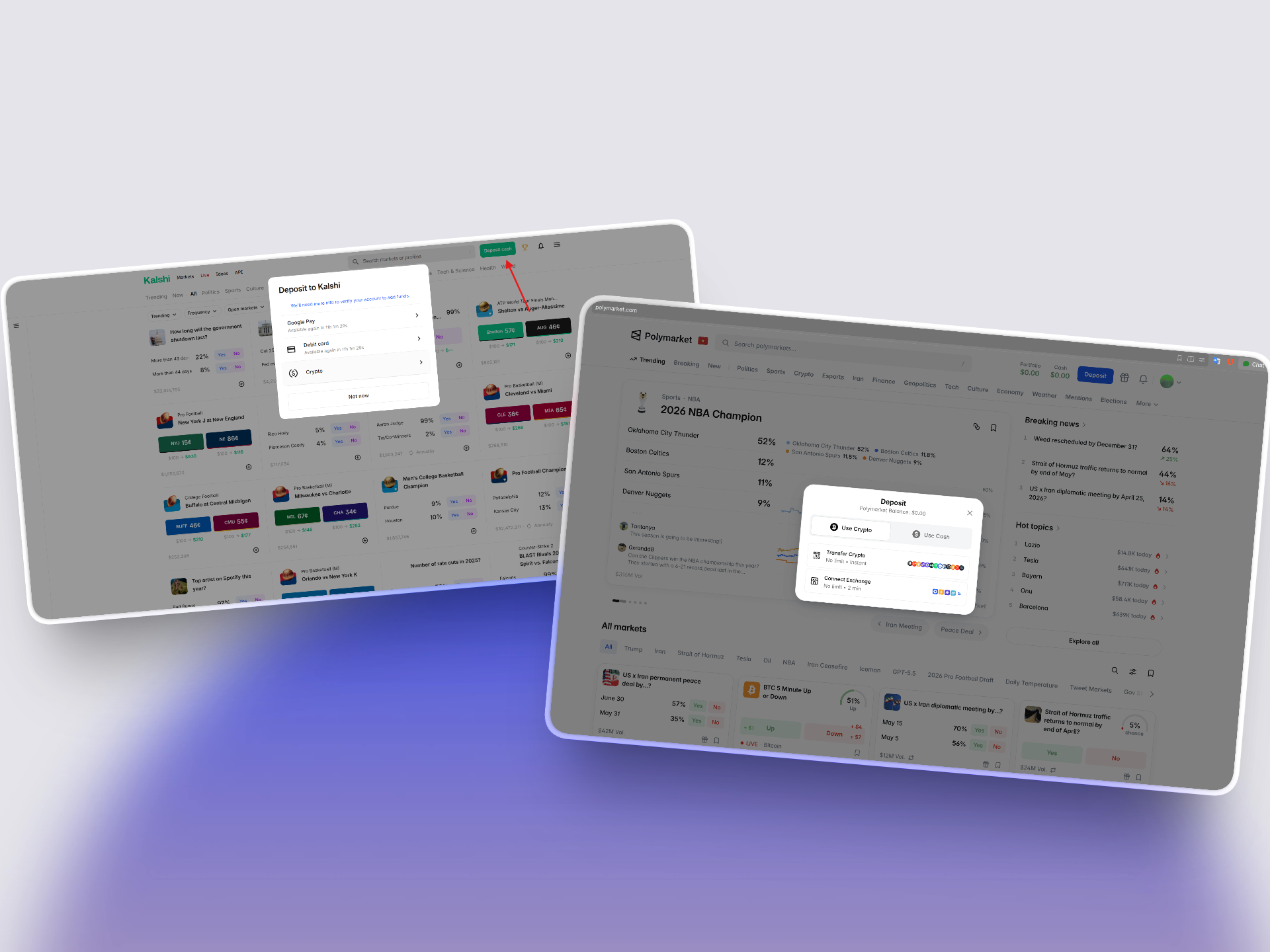
Polymarket’s US app smoothed a lot of this over in December 2025, but the main offshore site still expects you to hold USDC and understand basic Polygon mechanics before you place a single trade. Concretely, that means buying USDC somewhere (an exchange, usually), moving it to a wallet, then bridging or funding it onto Polygon if it isn’t there already, before you’ve placed a single trade. That’s a real 15-20 minute setup tax for a first-time user with no crypto background, and it’s the single biggest reason Polymarket scores “partial” rather than “yes” on beginner-friendliness. If you already hold USDC on Polygon from something else, none of this applies to you and the whole objection disappears.
Automation and tools
Both platforms expose a public API, so if you’re building bots rather than clicking buttons, neither locks you out. Kalshi runs a public REST and WebSocket API with a Python client, and its WebSocket feed is what most sports market-making bots are built on. Polymarket’s CLOB API ships Python and TypeScript SDKs, and its order-book model is friendlier to classic market-making strategies than Kalshi’s contract-pricing model.
Neither platform has native copy trading. On Polymarket’s side, third-party tools like WagerUp build copy-trading and terminal-style features on top of the public API, which is the pattern for most serious automation on either platform right now. If you’re specifically after wallet-level intelligence rather than execution, whale-tracking tools like GodEye watch Polymarket’s largest positions in real time, which is a different job than a trading bot and worth knowing the difference before you pick a tool.
Geographic availability
Kalshi is available in all 50 US states at the federal level, though the state-level legal challenges mentioned above mean “available” and “uncontested” aren’t the same thing yet in Nevada, New Jersey, or Massachusetts. Polymarket’s offshore site blocks US IPs outright, and its regulated US entity is the only legal path for US residents, currently rolling out state by state rather than nationwide on day one. If you’re outside the US, the offshore Polymarket site remains open with no KYC required.
Other prediction markets worth knowing
Kalshi and Polymarket aren’t the only two names in the category, and “neither of these two” is a legitimate answer for some readers. PredictIt is the oldest legal US political-markets platform, university-affiliated and narrower in scope, worth a look if you specifically want political contracts and don’t need Kalshi’s sports depth or Polymarket’s breadth. Myriad is a newer, smaller platform still building out its market selection, more relevant if you’re tracking where the category is headed than if you want deep liquidity today. Limitless is another newer entrant without a dedicated review on Predictionist yet, so treat any claims about it as unverified until we’ve actually tested it.
Which platform fits you
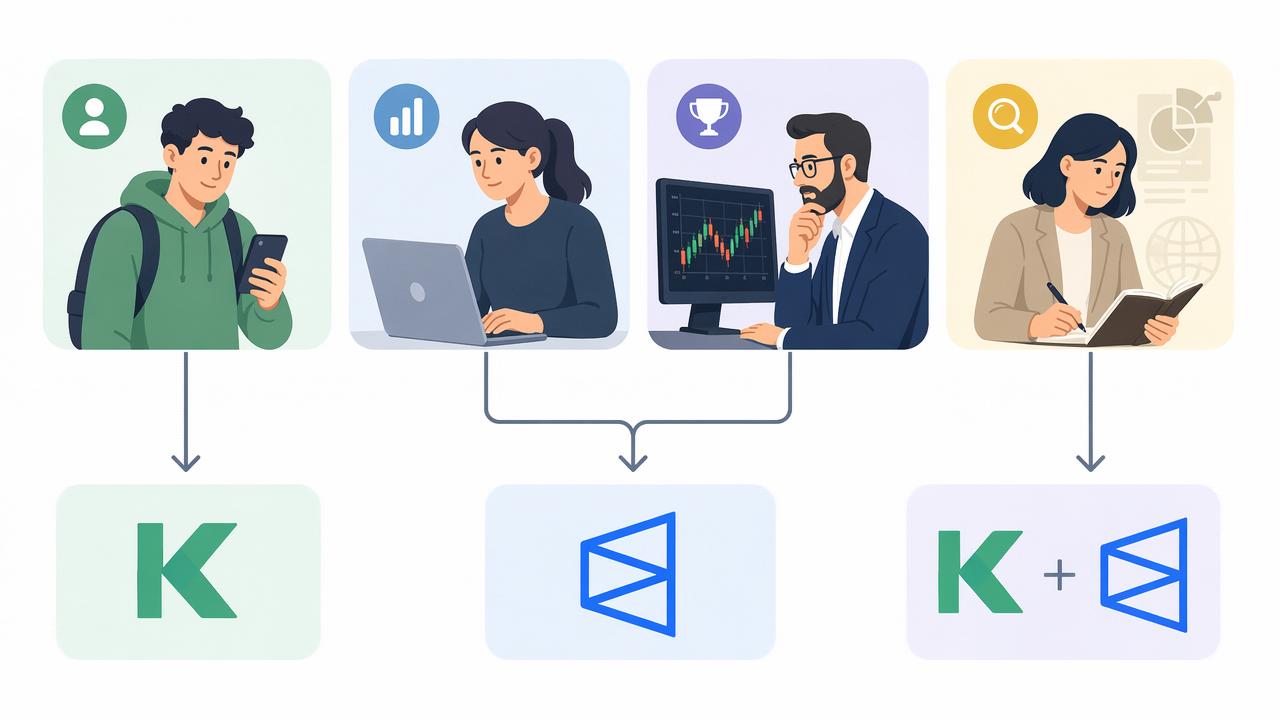
Newcomer, no crypto experience
Kalshi, close to without exception. Dollar funding, no wallet setup, distribution inside Robinhood and Webull if you already use either. You’ll be placing a trade in minutes, not after a 15-20 minute USDC-and-Polygon setup process.
Intermediate trader, comparison-shopping between the two
This is the closest call. If you’re US-based and want sports and political contracts without touching crypto, Kalshi. If you already hold USDC, or you specifically want the widest market variety (crypto, culture, global events beyond US-centric sports), Polymarket. A meaningful number of active traders just run both, Kalshi for dollar-funded sports and politics, Polymarket for everything else and the deeper book.
Pro trader, looking for execution edge
Go back to the liquidity breakdown further up before you pick a lane, the answer depends on the specific contract you’re trading, not the platform’s overall reputation. Kalshi’s WebSocket feed is what most sports market-making bots run on. Polymarket’s CLOB and visible order book suit classic market-making and arbitrage strategies better than Kalshi’s contract-pricing model does. Either way, read how order books and liquidity actually work before you size into anything, and if wallet-level intelligence matters more than execution speed, a tool like GodEye does a different job than either platform’s own interface.
Researcher or journalist, using this as a signal source
Polymarket’s larger volume and longer track record on major political and world events make it the more-cited data source in most coverage you’ll see referencing prediction-market odds. Kalshi’s CFTC-regulated status and growing sports book make it the more defensible source specifically for US sports and economic-data questions. Neither platform’s price is a guarantee of anything, it’s a market-implied probability, not a forecast, and it can be wrong.
Side-by-side verdict
Choose Kalshi if you’re a US-based beginner who wants to fund with a debit card, trade sports and political contracts, and never touch a crypto wallet. The regulatory track record is the longest in the category, even with the state-level fights still playing out.
Choose Polymarket if you already hold USDC, want the deepest liquidity and widest market variety, or want to build on a true central limit order book rather than contract-style pricing. The offshore site’s zero-fee structure on most markets is hard to beat if you’re comfortable with the crypto setup.
Plenty of active traders run both. Kalshi for sports and dollar-funded convenience, Polymarket for everything else and the deeper book. Read the full Kalshi review and Polymarket review before you fund either account, and if you’re still fuzzy on how the pricing itself works, our prediction markets primer covers the mechanics both platforms build on.
Frequently asked questions
Kalshi, for most beginners. It takes dollar funding through a debit card or bank transfer, needs no crypto wallet, and is available inside Robinhood. Polymarket’s offshore site still expects USDC and basic Polygon knowledge.
Polymarket covers more categories overall (politics, sports, crypto, culture, world events), while Kalshi has grown heavily sports-weighted, with sports now making up 75-90% of its volume.
Yes. Nothing stops you from holding accounts on both. Many active traders use Kalshi for dollar-funded sports and political contracts and Polymarket for crypto markets and deeper offshore liquidity.
States including Nevada, New Jersey, and Massachusetts have challenged Kalshi’s sports contracts specifically. Federal CFTC approval doesn’t automatically override every state gambling regulator, so check your state’s current status before funding an account.
Both scale with position size rather than charging a flat amount, so a $50 trade and a $5,000 trade pay the same percentage, not the same dollar figure. What actually moves the fee on either platform is the contract’s price, not its size: a coin-flip contract near 50¢ costs the most (percentage-wise) to trade on both Kalshi and Polymarket, while a near-lock at 5¢ or 95¢ costs next to nothing regardless of how much money is behind it.
Both run political contracts, but Polymarket has the longer track record and deeper liquidity on major political events, given its larger overall market size since 2020.
No. There’s no direct transfer between the two. You’d withdraw from one (bank transfer from Kalshi, USDC withdrawal from Polymarket) and fund the other separately through its own deposit method.
The original offshore site blocks US IP addresses, and using a VPN to access it violates its terms of service. Polymarket’s separate US-regulated entity, launched with CFTC DCM status in late 2025, is the legal path for eligible US residents.
Both expose public APIs with no native copy trading. Kalshi’s WebSocket feed suits sports market-making bots, while Polymarket’s CLOB API and order-book model suit classic market-making and arbitrage strategies.
Not for Kalshi. Not required for Polymarket’s US app either, but you’ll need USDC and a basic understanding of Polygon to use Polymarket’s main offshore site.
It’s a real, functioning platform that has paid out real settlements since 2020, and it now carries CFTC Designated Contract Market status on its US entity. That said, its search results and Trustpilot reviews carry genuine skepticism worth reading before you fund a large position, some tied to dispute-resolution friction that predates the regulated US entity. Real platform, real risk, not a scam in the fraud sense, but not risk-free either.
There’s no single winner, it swings by contract. A mainstream NFL market on Kalshi during football season can be as deep as anything on Polymarket. A niche economic-data contract on Kalshi, or a brand-new market on Polymarket, can both be thin enough that a large order moves the price. Judge the specific contract in front of you, not either platform’s overall reputation for depth.