
Prediction MarketsMastery School
A step-by-step curriculum to take you from beginner to a confident, informed prediction market trader.

Level 1
Fundamentals
- 1.1What Are Prediction Markets?A plain-language introduction to how prediction markets work, and why the price is the probability.
- 1.2How Pricing WorksHow a contract’s price translates into an implied probability, and where mispricing tends to show up.
- 1.3Your First TradeA full walkthrough of placing, holding, and resolving your very first trade.
- 1.4Understanding RiskThe real risks of trading prediction markets, and a simple rule for sizing your positions safely.
- 1.5Choosing Your PlatformHow to pick between Kalshi, Polymarket, and PredictIt based on where you live and what you want to trade.
Level 2
Market Mechanics
- 2.1Order Books and LiquidityHow order books actually work, and why the depth behind a price matters more than the price itself.
- 2.2Resolution and SettlementWhat actually happens when a market resolves, and why the fine print can matter as much as the outcome.
- 2.3Fees, Spreads, and the True Cost of TradingThe real cost of trading once fees, spreads, and slippage are added up, and how it differs by platform.
- 2.4Reading Market SignalsThe signals beyond price, like volume and whale activity, that reveal what’s actually moving a market.
- 2.5Cross-Platform DifferencesWhy the same event can trade at different prices on different platforms, and what that tells you.
Level 3
Trading Strategies
- 3.1Where the Edge Comes FromA grounded look at where a real trading edge actually comes from, before any specific strategy.
- 3.2Strategy: Cross-Platform ArbitrageHow arbitrage between platforms actually works in practice, and why it’s harder than it looks on paper.
- 3.3Strategy: Data-Driven TradingUsing historical data and base rates to spot pricing gaps that most traders miss.
- 3.4Strategy: Systematic Bias ExploitationHow to build a strategy around predictable biases in how crowds price long-shot outcomes.
- 3.5Strategy: Fundamental AnalysisA framework for researching an event more rigorously than the market has, using real-world context.
- 3.6Strategy: Market MakingHow providing liquidity on both sides of a market can earn the spread, and the risk that comes with it.
- 3.7Strategy: Event-Driven Trading
Level 4
Mastery & Systems
- 4.1Building Your Trading SystemHow to turn everything you’ve learned into a written system with clear rules, not just habits.
- 4.2The Trading JournalWhy keeping a trading journal is what actually separates skill from luck over time.
- 4.3Portfolio ConstructionHow to build a portfolio that’s genuinely diversified, not just spread across positions that move together.
- 4.4Trading PsychologyThe psychological traps that actually blow up accounts, and how to trade around your own biases.
- 4.5The Superforecaster MindsetWhat separates the best forecasters from everyone else, and how to think more like them.
- 4.6What’s Next – Your Trading PlanA concrete plan for turning what you’ve learned into consistent, ongoing practice.
Prediction Market Trading Course: The Complete Free Curriculum
Most “how to trade prediction markets” content on the internet is one article. Read it, and you technically know what a contract is. You still don’t know what to actually do with $200 and a Polymarket account.
The Predictionist School is built differently: 23 lessons across 4 levels, free, and sequenced so each one assumes only what came before it. It doesn’t stop at “here’s what a prediction market is.” It goes as far as building a personal trading system, keeping a trading journal, and managing the psychology that actually blows up most accounts.
This is a map of what’s in it, not a substitute for taking it.
TL;DR – What’s in each level
| Level | Lessons | Core question it answers | Standout lesson |
|---|---|---|---|
| 1. Fundamentals | 5 | What actually is a contract, and how do you place your first trade without getting hurt? | What Are Prediction Markets? |
| 2. Market Mechanics | 5 | How do prices form, and what actually happens when a market resolves? | Resolution and Settlement |
| 3. Trading Strategies | 7 | Where does an actual, repeatable edge come from? | Where the Edge Comes From |
| 4. Mastery & Systems | 6 | How do you turn one good trade into a system that survives 500 trades? | Trading Psychology |
New to all of this? Start at 1.1 and go in order. The strategies in Level 3 assume you already understand the mechanics from Level 2, skipping ahead just means re-reading it later anyway.
Level 1: Fundamentals
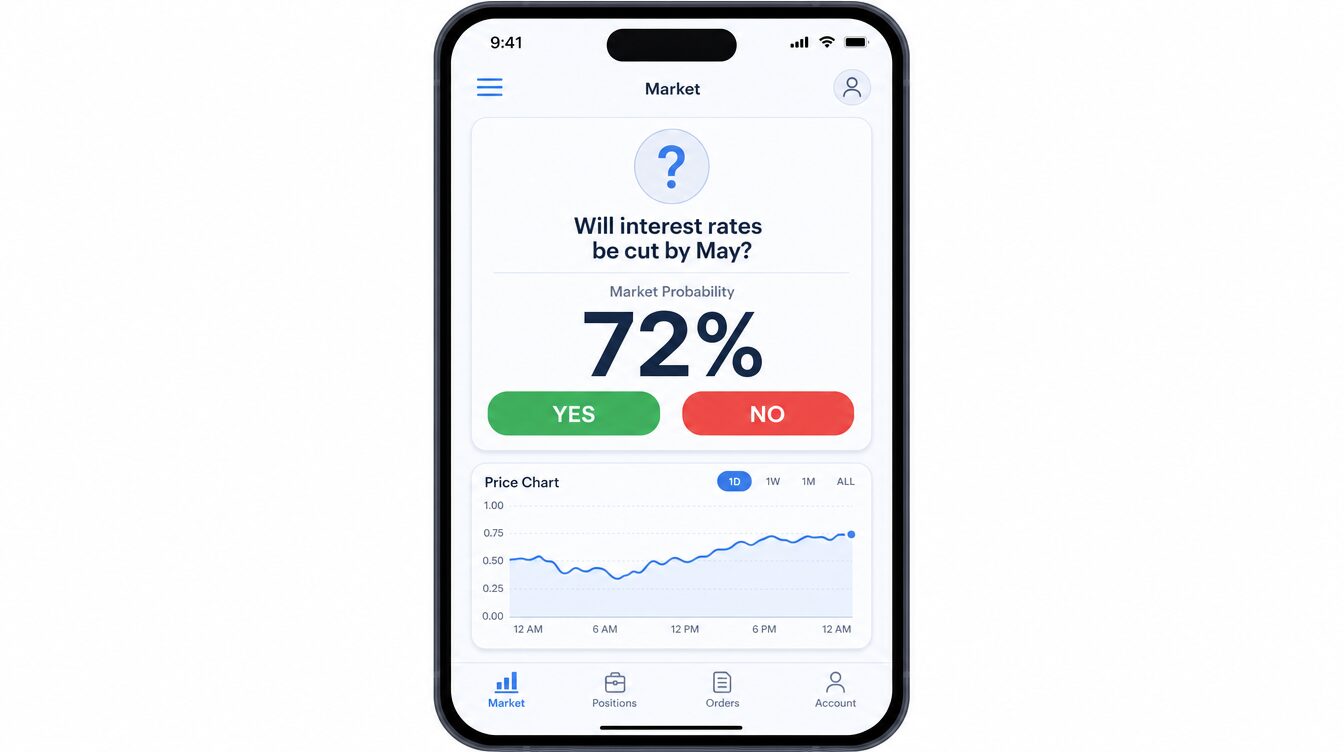
This is the level that answers “wait, how does this actually work?” What Are Prediction Markets? opens with the idea that runs through the entire curriculum: price equals probability. A contract trading at $0.72 isn’t a stock price, it’s the market’s collective bet that there’s a 72% chance the underlying event happens, illustrated with a plain “will Bitcoin hit $100,000 by December 31” example rather than abstract theory.
From there it’s practical fast: How Pricing Works, Your First Trade, Understanding Risk, and Choosing Your Platform, which is where the curriculum stops being Polymarket-only and starts treating Kalshi and PredictIt as genuinely different products, not clones with different logos.
Level 2: Market Mechanics
This is where “I understand the concept” turns into “I understand what can go wrong.” Resolution and Settlement opens with a real case: traders who were factually correct about a real-world outcome still lost money on a Zelenskyy-related market because UMA token holders interpreted the resolution criteria differently than expected. That’s the entire point of the lesson: resolution is the single moment that decides whether you get paid, and it isn’t always as clean as “the event happened.”
Order Books and Liquidity, Fees, Spreads, and the True Cost of Trading, Reading Market Signals, and Cross-Platform Differences round the level out, covering the mechanical stuff that a single blog post usually skips entirely because it isn’t exciting, right up until it costs you money.
Level 3: Trading Strategies
The biggest level, and the one most readers are actually here for. Where the Edge Comes From sets real expectations before teaching a single strategy: it opens with the fact that roughly 70% of Polymarket users lose money, and a vanishingly small share of wallets capture most of the gains. Edge, the lesson argues, comes from exactly three places, better information, more rigorous analysis of public data, or exploiting structural quirks in how a market is built, and it only shows up over many trades, the same way a casino’s house edge only shows up over thousands of spins, not one.
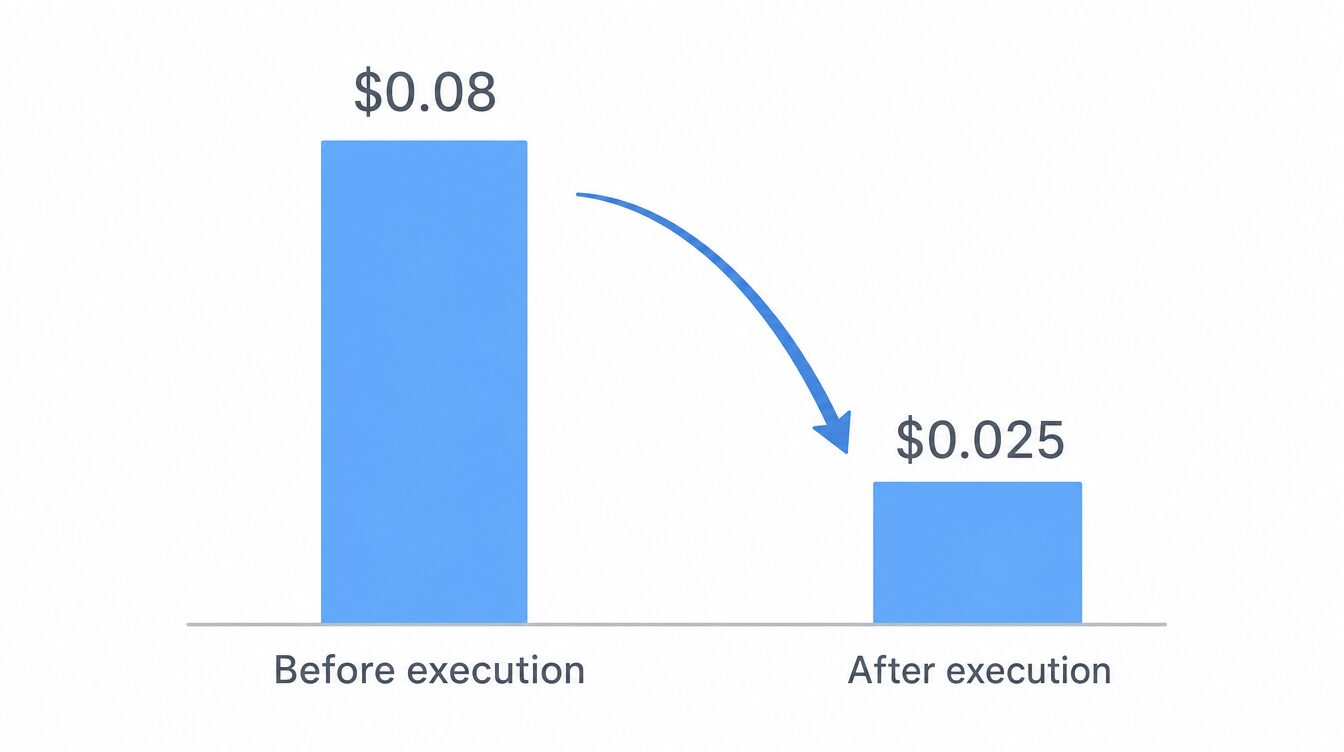
The five named strategies that follow get specific rather than motivational. Cross-Platform Arbitrage is the clearest example of the curriculum’s honesty: it walks through a textbook $0.08 spread that looks like free money, then shows exactly how execution friction cuts that down to $0.025, a 69% haircut, before handing over a six-point “every item must be a Go” checklist rather than leaving arbitrage looking easier than it is. Data-Driven Trading, Systematic Bias Exploitation, Fundamental Analysis, and Market Making cover the rest of the named approaches.
Level 4: Mastery & Systems
The level most trading content skips entirely, because “manage your emotions” doesn’t sell as well as “here’s my strategy.” Trading Psychology makes the case directly: your biggest opponent isn’t the market, it’s your own cognitive biases, and the fix isn’t willpower, it’s a system that makes emotional trades physically harder to place. It backs this with real data on revenge trading, losses on Polymarket cluster in streaks, and the trade right after a loss tends to go worse, not better.
Building Your Trading System, The Trading Journal, Portfolio Construction, The Superforecaster Mindset, and Your Trading Plan close things out by turning everything from Levels 1 through 3 into something you actually run, not just something you read once.
What makes this different from another prediction market guide
Search “how to learn prediction market trading” and most of what comes back is one of two things: a single long article that tries to cover everything at once, or a paid product. Learn Polymarket, for example, packages its deeper material as a $9.99 eBook alongside free blog posts, useful, but structured as a reference to dip into, not a sequence to work through.
The Predictionist School is free, fully sequenced, and deliberately not Polymarket-only, Level 1 alone treats choosing between Kalshi, Polymarket, and PredictIt as its own lesson rather than an afterthought. It also doesn’t oversell what it teaches: the arbitrage lesson talks you out of easy money, and the edge lesson opens with a stat about how many people actually lose. That’s a genuinely different promise than “3 strategies to win at prediction markets,” and it’s a promise most single-article guides don’t make because admitting the base rate isn’t good for engagement.
What the School doesn’t do yet
Worth being straightforward about this. The school’s own overview page lists a 3.7 “Event-Driven Trading” lesson as part of the 23-lesson curriculum, but that page isn’t live yet, so treat it as coming rather than available today. There’s also no video content, no quiz or certification at the end of a level, and no community or cohort element, it’s read-at-your-own-pace text, not a bootcamp. If you want the concepts reinforced with live discussion, that’s not what this is built for yet.

Who each level actually fits
Total newcomer, never placed a trade. Start at Level 1 and don’t skip Choosing Your Platform, picking Kalshi when you actually wanted Polymarket’s breadth (or the reverse) is an easy, avoidable mistake this lesson exists specifically to prevent.
Comfortable with the basics, losing money anyway. Level 2 is probably your gap. Most self-taught traders understand what a contract is long before they understand resolution risk or what a spread actually costs them per trade.
Have a thesis, want a repeatable process. Level 3 is built for you, specifically Where the Edge Comes From before any of the five named strategies, since it sets the realistic bar the strategies are measured against.
Already trade, but inconsistently. Level 4 is the one most people skip and shouldn’t. A trading journal and a written plan sound like homework right up until the moment they’re the only thing standing between you and a revenge trade.
Frequently asked questions
Yes, all 23 lessons are free to read, no signup or payment required.
You don’t have to, but it’s built that way for a reason. Level 3’s strategies assume you already understand order books, resolution, and fees from Level 2, skip ahead and you’ll likely end up back-reading anyway.
No. [Choosing Your Platform](/school/choosing-your-platform/) in Level 1 and [Cross-Platform Differences](/school/cross-platform-differences/) in Level 2 both treat Kalshi and PredictIt as genuinely different products, not Polymarket clones.
[Where the Edge Comes From](/school/where-the-edge-comes-from/). It sets honest expectations, most traders lose, before teaching a single strategy, which is the context every other lesson in Level 3 assumes you already have.
No, and [Cross-Platform Arbitrage](/school/cross-platform-arbitrage/) is built specifically to walk that assumption back with a real example: a seemingly free $0.08 spread that shrinks to $0.025 once execution friction is accounted for.
Not currently. It’s a straight read-through curriculum, no quizzes, no certification, no cohort.
Cost and structure. The School is free and organized as a numbered sequence; most paid alternatives are reference material you dip into rather than a level-by-level course you complete.